Working Group on Gulf Foreign Policy: Meeting III – Key Takeaways
Fiker Institute’s Working Group on Gulf Foreign Policy held its third meeting on 29 April 2026, bringing together expert voices from the six Gulf Cooperation Council (GCC) countries to exchange views on the current developments and the future trajectories of GCC states’ foreign policies.
The takeaways below are a summary of the discussions and reflects multiple perspectives. They are not a unified view of all participants and do not represent Fiker Institute.
KEY TAKEAWAYS
On the parties’ divergent demands for a ceasefire deal
As negotiations on a peace deal between the United States (US) and Iran remain stalled, the Working Group discussed what terms each side might accept. Since the ceasefire announcement, the focus of discussions appears to have shifted to the Strait of Hormuz crisis with less attention on the issue of ballistic missiles and Gulf security guarantees. Nevertheless, Iran, the US, as well as the different GCC states, remain divided on what terms would be acceptable to them. Both Washington and Tehran will need a deal they can present as a win. Iran is demanding sanctions relief, the lifting of the US naval blockade, and credible guarantees against future attacks. The US, on the other hand, wants a comprehensive agreement including assurances on the nuclear file and is using both military and economic means as leverage.
Beyond the substance of the talks, the Working Group also highlighted the question of sequencing. Tehran appears to prefer a phased agreement in which the issue of maritime trade and access in the Strait of Hormuz is addressed first and the nuclear file is left to a later stage. This approach may facilitate an initial agreement between the US and Iran without any side being forced to make immediate concessions on key sensitive files. However, Washington may see this differently. Some members pointed out that President Trump may see the current moment as one of maximum leverage and thus push for nuclear concessions right away. Some members argued that a sequenced agreement appears more likely than a grand bargain, though such a framework could create opportunities for spoilers, while others cast doubts on whether even a phased deal is possible.
On the likelihood of a lasting deal
The Working Group also discussed the practical hurdles to achieving a deal and the likelihood of any agreement surviving in the long term. Some argued that the current stalemate serves both the US and Iran and that both sides are preparing for a resumption of conflict, potentially in a few weeks or months. In this light, any concessions being made at this stage are merely helping the parties position themselves for a renewed round of conflict: Iran is unlikely to make any concessions on the Strait of Hormuz, while the US is aligned with Israel in wanting to resume conflict once clearer objectives are set and capabilities are reinforced.
On the negotiations themselves, the Working Group pointed to different emerging negotiating tracks. Going forward, different mediators may take forward different issues. For example, Pakistan may lead discussions on the nuclear file, bringing together interlocutors including Russia, China, and the International Energy Agency, while Oman may lead on the Strait of Hormuz and maritime security with Gulf states being important actors for backchannel mediation. The Group also pointed out the practical difficulties presented by Iran’s fragmented domestic leadership. The US administration appears unwilling to make a deal with Iran as long as it does not see a unified leadership in Tehran. Moreover, for any deal to have credible longevity beyond the Trump administration, it would have to be ratified by the US Congress, which is challenging, especially in light of the upcoming midterm elections. Finally, some members highlighted the challenging information environment in which the current negotiations are taking place. The rampant misinformation and disinformation are making it difficult to assess each parties’ intentions and capabilities.
On Gulf states’ perspectives on a deal
As for the Gulf, some members argued that GCC states may be less concerned with who claims victory than whether the deal can reduce uncertainty. Stability in the Strait of Hormuz, lower risks to energy infrastructure, and fewer triggers for renewed escalation are key priorities for the region.
However, there is a lack of alignment among GCC states on what they would want from a ceasefire agreement or whether a deal is desirable at all. While some states are pushing for a more long-term deal to address the Iranian ballistic missiles and drone programs, as well as the nuclear issue, others appear to be prioritizing a short-term solution focused on reopening the Straits. Moreover, it is unclear whether GCC states would feel bound by the terms of any deal set by the US and Iran, notably if they concern sanctions relief. Gulf capitals may have differing positions on whether to isolate Iran economically and diplomatically going forward.
The Working Group agreed that a key issue which is preventing a more unified Gulf stance is the divergent threat perceptions and difficulty in identifying a joint enemy. GCC states have not clearly identified whether their enemy is a state, a non-state actor, a regime, an ideology, or sectarianism more broadly. Some members also argued that the GCC states’ position regarding the desirability of regime change in Iran may have changed in light of the domestic security threat of Iran-backed sleeper cells. Similarly, the GCC states need to align on what a joint posture would entail, from a joint defense doctrine to diversified procurement.
Nevertheless, some key issues that Gulf states are likely to rally around are the international legal principles of non-aggression and the non-targeting of infrastructure and for Iran to stop using proxies in the region. The immediate concern of attacks targeting civilian infrastructure, airports, and water supplies is central for the stability of life and business in the Gulf. Similarly, Iran’s use of proxies in Iraq, the Houthis in Yemen, or sleeper cells in Gulf states present a risk all GCC states are keen to avoid.
On the issue of arms control, the Group raised the question of whether the Gulf states would be willing to engage in restrictions as well, as arms control arrangements tend to require reciprocity. Moreover, for Iran, the main concern is Israel and the US, both of which are not interested in arms control. Iran is thus unlikely to agree to any limits on their conventional arms production at this stage.
Finally, some members questioned what the Gulf states could offer Iran in a negotiation since their defensive posture during the war has left them without offensive bargaining chips. Some incentives raised included Gulf states circumventing US sanctions or advancing economic ties with Iran. Members also underscored the importance of establishing a direct negotiating track between the GCC states and Iran that is independent of negotiations with the US.
On the implications for Gulf cooperation
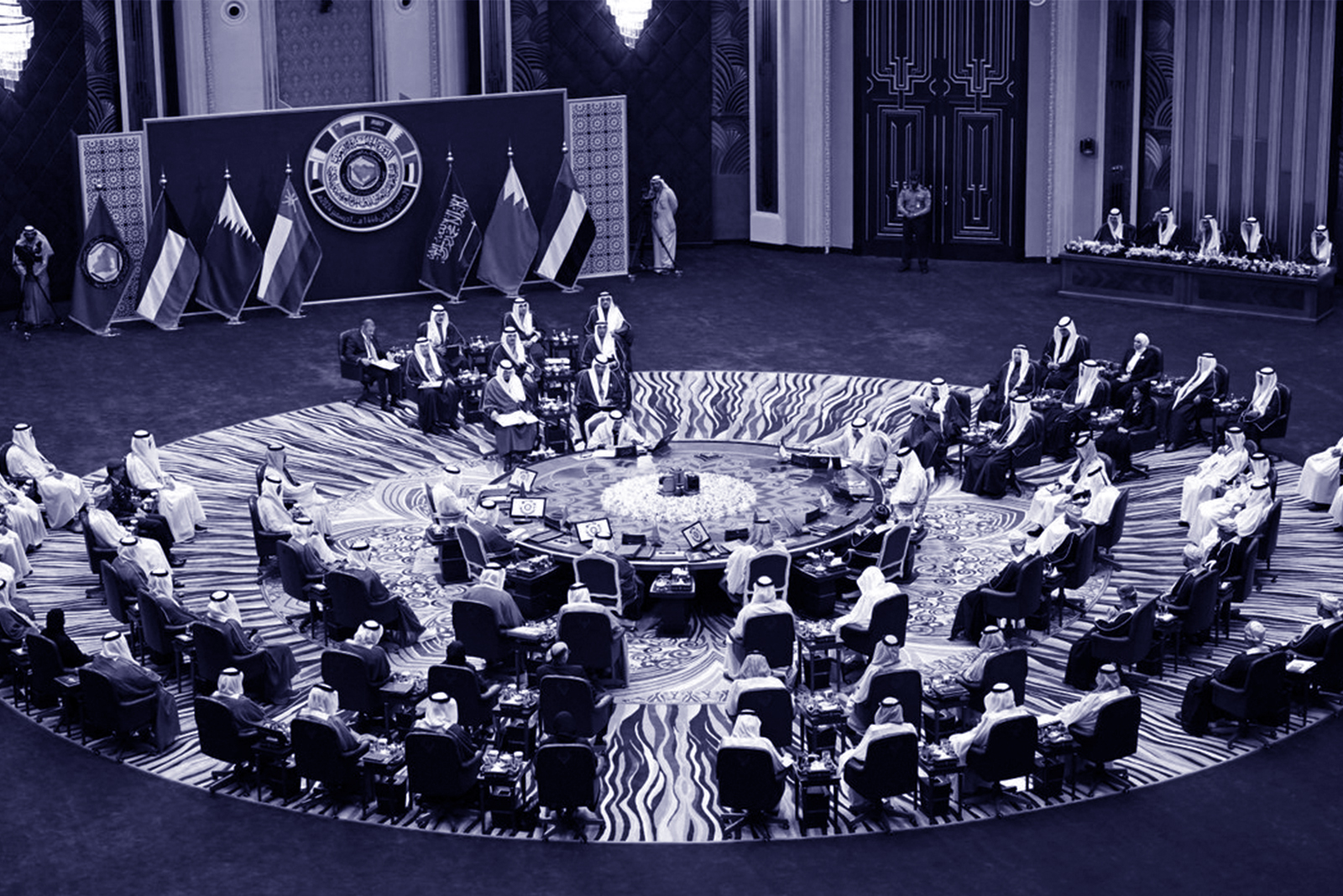
Some Working Group members highlighted that the GCC’s extraordinary summit on 28 April 2026, sent an important message that the bloc is still committed to working together. Others highlighted that the summit demonstrated that Gulf leaders are thinking beyond the conflict itself and expediting regional projects to strengthen connectivity and reduce the exposure of critical infrastructure and supply chains to disruption. Especially in terms of economic coordination, the GCC states have been relatively effective in supporting each other with trade logistics during the war; this could be an area for further cooperation going forward. On the other hand, some members highlighted that the differing levels of representation at the summit shows a lack of unity among member states when it comes to what pathways are most beneficial in the immediate term.
The war has also forced Gulf states to reckon with the current security architecture in the region. Some Working Group members argued that this has shown the fragmented nature of the security deals Gulf states have lived under for the past 40 years, highlighting differential and asymmetric arrangements with the US, differing stances on relations with Israel and Iran, and varying positions on the US attacks on Iran. Some argued that the limits of Gulf states’ sovereignty and independent decision-making power are demonstrated when national security is threatened by the consequences of decisions made by proxy rather than by Gulf states themselves.
On the prospect for guarantors of a deal
The Working Group discussed which actors could constitute credible guarantors for a deal. Historically, agreements in the region have struggled as much with implementation as with negotiations in the first place. Ceasefires and agreements in the past have held temporarily but have broken down once incentives have changed or trust has been eroded. In this context, the question of guarantors is not only theoretical but constitutes a key constraint for any deal.
Some members argued that – for both guarantors and mediators – it is important for actors to speak the same language. For example, Pakistan’s leadership including Field Marshal Munir may be more suited to negotiating with the IRGC than Oman’s who have held regular talks with Foreign Minister Araghchi and Iran’s civilian leadership. Moreover, some members argued that any deal of this scale would need to be guaranteed by a superpower. While the US has leverage, it is a direct party to the conflict. China would be able to support Iran militarily and economically and has gained regional influence, however it is unclear whether China would want to take this role and whether all parties would view Beijing as a neutral actor.
The most realistic model may not rest on a single guarantor but a framework of layered guarantees. On the nuclear file, actors like China, the European Union, or the International Atomic Energy Agency could provide verification, while the International Maritime Organization could oversee the process of guaranteeing freedom of navigation in the Strait of Hormuz. Such an arrangement could include major powers providing leverage, regional actors supporting stability, and economic interdependence creating pressure against returning to escalation.
PARTICIPANTS
The third Working Group was attended by:
- Ahmed Buhejji (Bahrain), First Secretary at Ministry of Foreign Affairs of Bahrain & Al-Khaleej Fellow at Fiker Institute
- Aisha Al-Sarihi (Oman), Nonresident Fellow at the Middle East Council on Global Affairs & the Arab Gulf States Institute
- Dr Bader Al-Saif (Kuwait), President of Al-Saif Consulting
- Dubai Abulhoul (UAE), Founder of Fiker Institute
- Dr Hasan Alhasan (Bahrain), Senior Fellow at the International Institute for Strategic Studies
- Dr Haya Al-Noaimi (Qatar), Assistant Professor at Northwestern University in Qatar
- Dr Khalid Al-Jufairi (Qatar), Adjunct Associate Professor at Georgetown University in Qatar & Al-Khaleej Fellow at Fiker Institute
- Mahdi Jasim Ghuloom (Bahrain), Junior Fellow in Geopolitics at the Observer Research Foundation – Middle East
- Dr Naser Alsayed (Bahrain), Queen Elizabeth II Academy Fellow at Chatham House
- Nayef Al-Nabet (Qatar), Nonresident Fellow at the Middle East Council on Global Affairs
- Dr Nourah Shuaibi (Kuwait), Assistant Professor at Kuwait University
- Rumaitha Al Busaidi (Oman), Vice President of the Environment Society of Oman & Al-Khaleej Fellow at Fiker Institute
The statements made and views expressed do not represent Fiker Institute.