War, Vulnerability & Omnibalancing: Rethinking Gulf Security
The current war on Iran has exposed structural vulnerabilities in the United States (US)-Gulf security alliance. This is exemplified by the basing paradox: the hosting of US forces increases deterrence while simultaneously elevating exposure to retaliation. Iran’s retaliatory strikes on US regional assets and Gulf infrastructure have drawn Gulf Cooperation Council (GCC) states into the conflict, demonstrating how forward presence can transform partners into operational targets regardless of their direct involvement. This dynamic has intensified scrutiny of whether US-Gulf security frameworks translate into credible protection or merely redistribute risk across host territories.
This Policy Brief argues that the future of the US-Gulf security alliance and the collective Gulf security architecture depend on converting US presence into integrated protection through interoperable air and missile defenses, shared early warning, and joint command structures. As US priorities shift and multipolar partnerships expand, GCC states will pursue greater collective autonomy while preserving US cooperation. The Brief presents scenarios for the future of the US-Gulf security alliance which will hinge on whether hosting arrangements can be legitimized through credible defensive integration and whether a Gulf-centered security architecture can absorb strategic uncertainty without eroding the structural foundations of US-Gulf security credibility. It concludes that the war has reinforced a broader lesson: military capability alone is insufficient to guarantee strategic control without politically viable protection arrangements in which the political meaning of US presence can be renegotiated.
FRAMING OMNIBALANCING
Conventional balance of power theory contends that states align primarily to counter external threats, yet this assumption inadequately captures the foreign policy behavior of GCC states. In highly centralized political systems where government security and domestic legitimacy are pivotal, alignment decisions are filtered through policymakers’ perceptions of both internal vulnerability and systemic constraint. Omnibalancing provides a more analytically robust framework by conceptualizing alignment as a strategy through which domestic and external threats are managed for political survival.1 Accordingly, the strategy of omnibalancing enables governments to accept external dependence, adopt selective accommodations, or forge surprising partnerships,2 all in an attempt to neutralize government-threatening risks.
GCC states are not passive security actors; rather, they practice omnibalancing by externally aligning partnerships against threats of political instability.3 This Gulf foreign policy behavior is best understood through the logic of strategic hedging.4 Since February 28, 2026, the GCC states have had to defend their territorial sovereignty while balancing a hedging approach with the US against Iranian retaliatory strikes. To that effect, the war on Iran has become a stress test for GCC states’ omnibalancing strategies that explains which foreign policy approaches are acceptable within their strategies of hedging.
GULF SECURITY ARCHITECTURE
Omnibalancing theory assumes that governments’ threat calculus is shaped by external alignments and challengers as well as domestic pressures.5 For the GCC states, the two salient omnibalancing imperatives are the Gulf’s security architecture as well as regional rivalries and threat reconciliation. In fact, the Gulf’s security architecture conditions GCC states’ legitimacy and internal stability.6 Historically, it has long focused, and continues to rest on, US strategic commitments.7 The US’ national interest in the Gulf was laid out in the Carter Doctrine following the 1979 Islamic Revolution in Iran: the US declared that attempts by an outside force to gain control of the Gulf bloc would be treated as an assault on vital US interests and could be repelled “by any means necessary, including military force.”8 Carter’s words signaled that Gulf security was not merely a regional issue, but a strategic priority tied to US hegemony.
Militarily, the US has created force-posture mechanisms to operationalize its commitments to GCC states through establishing the US Central Command (CENTCOM), which originated in the Rapid Deployment Joint Task Force created after the 1979 Iranian Revolution and the Soviet invasion of Afghanistan.9 CENTCOM was activated as a permanent unified command in January 1983, and the 1990-91 Gulf War accelerated US-Gulf defense institutionalization. Even though GCC states had early collective defense aspirations, the war exposed the strategic and political costs of dependence on US-led coalition power, especially the vulnerability of host territories to retaliation and the limits of external security guarantees under conditions of regional escalation. After the 1990-91 war, the US signed a series of Defense Cooperation Agreements with its Gulf partners to provide military training, force access, and the prepositioning of military equipment and logistical assets for rapid deployment: Kuwait and Bahrain in 1991, Qatar in 1992, and the UAE in 1994;10 Oman and Saudi Arabia had previously signed agreements in 198011 and 195112 respectively.
US GUARANTEES
Over time, US strategic commitments provided GCC states with three concrete advantages. First, they established a basing and access architecture capable of supporting rapid air, naval, and logistical operations across the Gulf. Qatar’s long-term investment of more than $8 billion in the development of Al Udeid Air Base illustrates the reciprocal nature of this arrangement:13 while the base enabled US regional force projection, it also reinforced Qatar’s deterrence posture, deepened its strategic relationship with Washington, and embedded Doha within the core infrastructure of US regional security commitments. Second, they created legal-political status designations for GCC states that deepened defense cooperation even without formal alliances. A number of GCC states have received Major Non-NATO Ally (MNNA) status in presidential determinations including Bahrain in 2002,14 Kuwait in 2004,15 Qatar in 2022,16 and most recently, Saudi Arabia in 2026.17 However, these MNNA statuses only provide specific cooperation benefits and do not amount to a mutual defense pact similar to NATO.18 Third, they guaranteed US interoperability, including its arms-supply contracts which have defined GCC states’ force design and readiness. According to the Stockholm International Peace Research Institute (SIPRI), US arms transfers remain central to GCC states’ militaries, which continue to operate in a predominantly US defense ecosystem. Notably, the US remained the world’s largest arms exporter in 2021–25, accounting for 42% of global exports. Although Europe became the largest destination for US arms exports, Middle Eastern countries still received 33% of US transfers, with Saudi Arabia, Qatar, and Kuwait among the top US recipients.19 This dependence is further evidenced by US foreign military sales notifications covering systems such as F-15 sustainment equipment20 and Patriot missile systems,21 both for Saudi Arabia, and Patriot sustainment equipment and upgrades for Kuwait.22
This concentration of US defense procurement fosters technical compatibility across platforms, including shared command-and-control systems, logistics pipelines, sustainment arrangements, and maintenance support structures.23 As a result, GCC militaries increasingly organize force development around US-origin systems and security assistance channels, aligning training cycles, doctrine development, logistics, and sustainment with US operational requirements.24 To that effect, US interoperability is not merely a technical outcome but a structural feature of Gulf force posture, enabling rapid coalition formation and enhancing readiness for joint operations.
INTEROPERABILITY FRICTIONS
The current war on Iran has exposed interoperability gaps and command-and-control frictions within the US-Gulf security framework, accelerating GCC states’ efforts to institutionalize a more integrated and regionally anchored defense architecture. Although US-Gulf interoperability facilitates rapid joint deployment, logistical coordination, and operational integration, the current war with Iran has reinforced Gulf concerns that hosting US forces without credible defensive guarantees can expose GCC states to retaliation and strategic entrapment. This concern intersects uneasily with the Trump administration’s National Security Strategy, which calls on “wealthy, sophisticated” allies to “assume primary responsibility for their regions.”25 While Washington frames burden shifting as a means of sustaining a US-centered regional order, GCC states increasingly frame security through the language of sovereign collective self-defense under Article 51 of the UN Charter and emphasize that Gulf territory should not become an arena for proxy or externally driven conflicts.26 This approach reflects a subtle but important divergence between US expectations of regional burden sharing and Gulf efforts to preserve strategic autonomy and limit escalation exposure, highlighting how GCC states are increasingly framing the Gulf security architecture as a matter of collective sovereignty and not merely as host-nation support to external powers.
To that effect, the repositioning of the Gulf’s security architecture will not solely depend on a single US decision, but on the drivers of cumulative US reprioritizations. For GCC states, their collective security strategy should rest on institutionalizing an integrated Gulf defense and protection system, resilient to shifting US priorities and credible against external threats. To operationalize this strategy, the core alliance problem is credibility. As US bases create exposure, protection must be visible enough to justify the risks.27 The most practical policy options are as follows: renegotiating basing and accessing understandings around security deliverables, rather than relying on implied expectations; incorporating shared early warning and joint command relationships to reduce coordination failures;28 implementing consultation mechanisms to avoid escalation pathways;29 and adopting measurable base and critical infrastructure defense strategies, including integrated air and missile defense (IAMD) coverage and redundancy for ports, airports, and desalination plants.30
FOUNDING A GULF SECURITY WEB
The current Iran War demonstrates that US bases are not the only targets vulnerable to attack; sustainment nodes and ports can also become targets, and dispersed operations can still be vulnerable. Since the US presence in the Gulf relies heavily on sustainment hubs and prepositioned stocks, GCC states should integrate hardened logistics sites, redundancy in port and airport operations, and rapid repair and continuity-of-government planning. To do so, GCC states should found a security web by partnering with external powers, not as a substitute to the US presence, but as modular additions to complement the existing Gulf security architecture. Additionally, a Gulf security web should be anchored in a shared Gulf crisis doctrine31 that aligns the collective response mechanisms of the six GCC states and sets out a clear legal framing for thresholds for Gulf self-defense, transparent protection-of-civilians commitments, and formal coordination mechanisms with key partners for maritime and airspace security.32
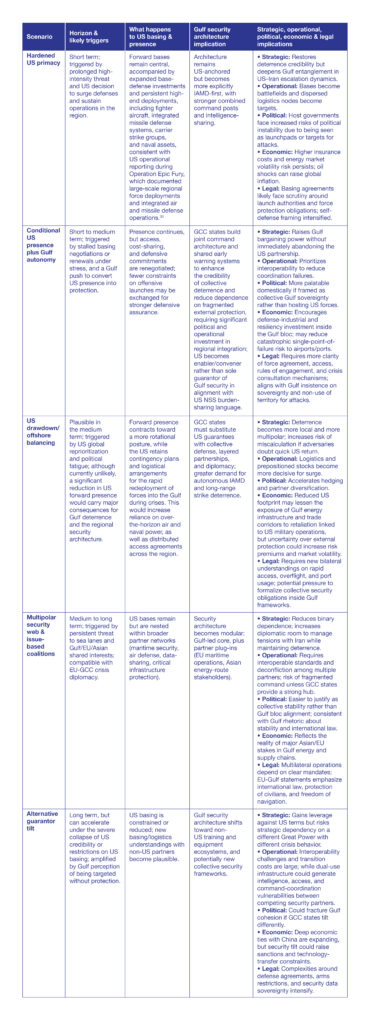
The future scenarios of such a Gulf security web embed alliance and architecture outcomes driven by basing politics, burden shifting, and emerging and multipolar partner options. Based on Gulf-EU joint statements33 as well as a March 2026 strategic foresight assessment published by Futuresmaker, an independent Kuwait-based foresight and strategic intelligence platform,34 the table below compares different scenarios, focusing on US bases and force posture, and the resulting Gulf security architecture choices across short (1–3 years), medium (3–10 years), and long-term (10+ years) horizons.
CONCLUSION
The future of the US-Gulf security alliance will depend less on the US’ ability to deploy forces and more on whether hosting arrangements can be politically sustained through credible protection. The different scenarios demonstrate how forward basing, understood as the long-term stationing of military personnel, equipment, and facilities abroad for deterrence, rapid response, and power projection, has increasingly been interpreted as both a security guarantee and a source of vulnerability.36 This duality becomes acute when host GCC states are exposed to retaliation without visible defensive guarantees.37 This shift redefines the Gulf’s security architecture from a logistics-centered partnership to a legitimacy-centered one, in which the domestic and regional acceptability of hosting US bases becomes the decisive variable. In this context, force presence alone is insufficient; the US-Gulf security alliance must demonstrate that hosting bases tangibly reduces vulnerability rather than redistributes risk.
The current war on Iran has exposed weaknesses not in the scale of US combat power, but in the political and operational alignment between US and host-state defense priorities. The credibility of the alliance therefore depends on visible deliverables: shared early warning, interoperable air and missile defenses, and joint command arrangements that transform presence into protection. Without these mechanisms, basing risks becoming politically unsustainable, especially when under pressure from domestic militaries and wartime public scrutiny. Conversely, when hosting bases is embedded within a multilayered defensive architecture, it can be reframed as an instrument of sovereign security rather than external dependency.
Equally important is the development of a collective Gulf-centered security architecture capable of absorbing shifts in US priorities. A resilient Gulf architecture must anchor interoperability and command integration within Gulf frameworks, allowing external partners to function as modular contributors rather than primary guarantors. This approach can reduce vulnerability while preserving deterrence credibility. It can also mitigate the fragmentation that arises from competing security ecosystems.
Ultimately, the future of the US-Gulf security alliance will hinge on renegotiating the political meaning of US presence. If hosting bases evolves into a credible framework for integrated defense and collective adaptability, the partnership can withstand burden shifting and alignment pressures. If not, forward basing will be reinterpreted as exposure, accelerating omnibalancing behavior and eroding the structural foundations of US-Gulf security credibility.
The statements made and views expressed are solely the responsibility of the author, and do not represent Fiker Institute. To access the endnotes, download the PDF.