US-Gulf Relations: Power, Risk & Regional Order
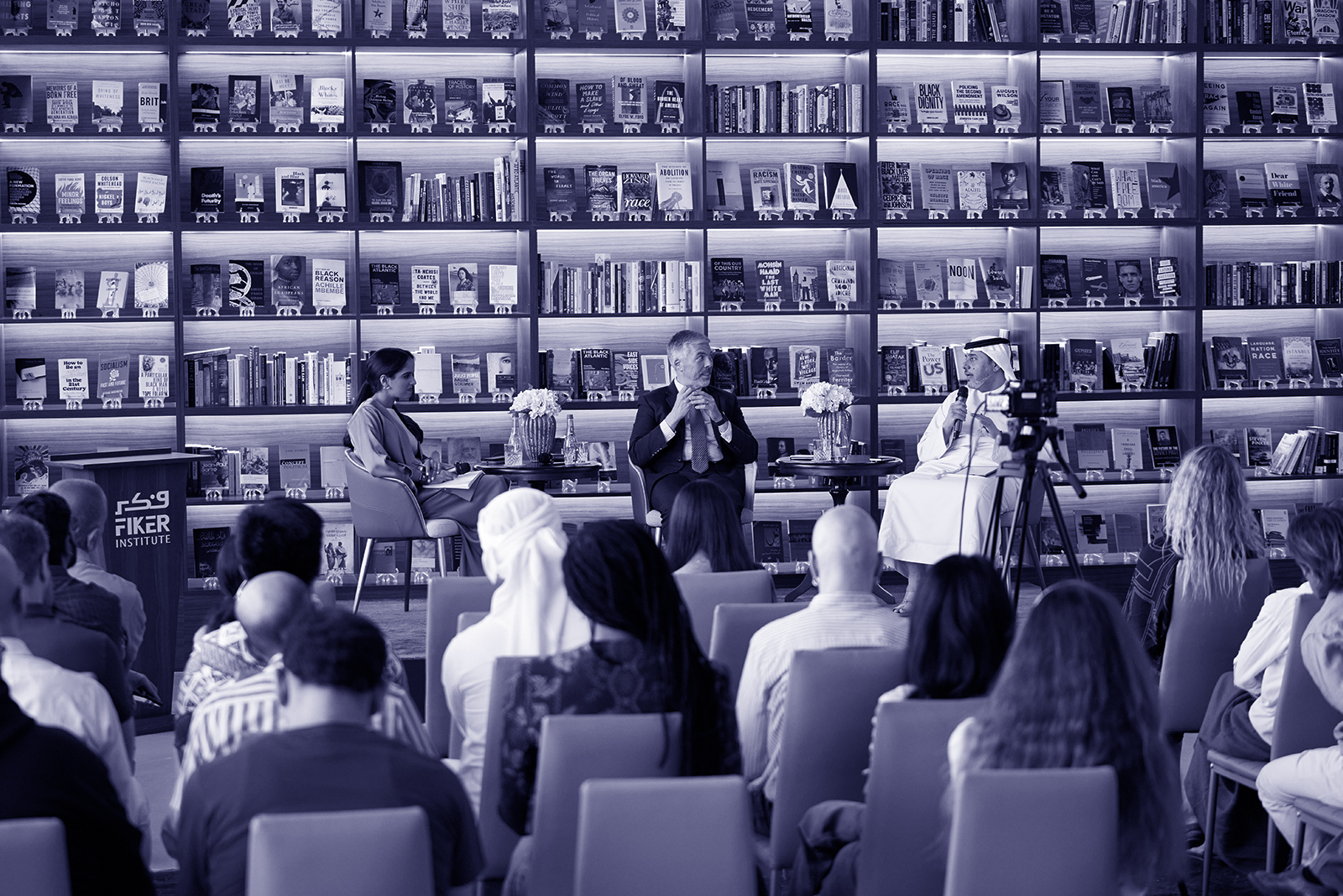
Amid rising regional tensions and while the strategic calculus of the war is being reshaped by negotiations in Islamabad, Fiker Institute hosted the Director General of b’huth (Dubai Public Policy Research Centre) Mohammed Baharoon and Associate Professor of Political Science at NYU Abu Dhabi Adam Ramey to discuss what is at stake for Gulf security, shifting alliances, and the broader balance of power. Below are the key takeaways from the session.
WHERE DOES THE GULF STAND TODAY AS A BLOC?
Within the Gulf Cooperation Council (GCC), there is a tremendous diversity of viewpoints, ranging from Oman’s nonconfrontational and conciliatory approach as a mediator in comparison to other states like the United Arab Emirates (UAE) and Bahrain. While it might therefore be a stretch to speak of “unity” among the GCC states, “coordination” more accurately captures their current standing as a bloc. And it is in continued and even increased coordination that the future of the bloc lies.
Being among the hardest-hit countries in a war they actively advocated against, the GCC states have been largely sidelined from the negotiation process. Though their inclusion in this process is imperative, it is unclear who would speak for the Gulf states if they were included in negotiations. If each state were to be given a seat at the table, the diversity of opinions could be viewed by the US as an impediment to reaching a deal in the shortest time possible.
The failure to include the GCC states as primary actors in negotiations thus far does not mean, however, that their views have had no influence on shaping the trajectory of the war. Regular behind-the-scenes communication between President Trump and leaders such as the UAE President and the Saudi Crown Prince have likely been taking place. However, there is a danger that Trump’s desire for expediency might drive him to concede to Iran on matters that would be counter to GCC interests. Despite their close alignment with the US, the Gulf states differ on key priorities. For example, while controlling Iran’s nuclear program might be the biggest concern for the US, a complete and unconditional reopening of the Strait of Hormuz is viewed by some in the Gulf as a more urgent imperative.
WHAT WILL THE US-GULF RELATIONSHIP LOOK LIKE IN THE IMMEDIATE AND LONGER TERMS?
The US-Gulf relationship will not only persist beyond this war, but it is probable that it will grow stronger. For the UAE, the country is likely to double down on purchasing US defense equipment. Under the US-UAE defense partnership agreement, the two countries may also strengthen efforts to conduct joint training, research, and financing of projects and startups. On the one hand, this is due to the history and durability of US-Gulf ties. On the other, there are no credible alternatives to the US defense partnership for the Gulf at present. This has been underlined by the inability of multilateral organizations to intervene meaningfully in the current war, with the ceasefire owing to small-scale talks taking place outside the framework of major international institutions. Furthermore, US military equipment and air defense systems have proven to be very effective throughout the war. What adds to the imperative of maintaining the strong US relationship for Gulf states is the possibility that the post-war Iranian regime will be an even more radical version of what it was prior to the conflict, continuing to constitute a threat to its neighbors.
In terms of US foreign policy in the Gulf moving forwards, the Trump administration has had a very good working relationship with countries in the region. However, there is a significant camp of individuals in the Republican Party, including the current Vice President and potential 2028 presidential nominee JD Vance, who do not want the US to be involved militarily overseas, particularly in the Middle East. This isolationist stance is also being increasingly adopted by Democrats. It is not improbable, therefore, that Trump’s successor will not be as interested in maintaining the current US campaign against Iran. If Tehran resorts to aggression once again in the next few years, a future US president might adopt a stance similar to that taken by European leaders such as British Prime Minister Keir Starmer and French President Emmanuel Macron during the current conflict, privileging rhetoric over direct intervention. In certain aspects, the awareness of the finiteness of Trump’s presidency has strengthened Iran’s negotiating position in the current negotiations.
Accordingly, Gulf countries will have to create a sustainable security framework that functions regardless of who is in the White House in addition to reinforcing existing warm relations with the US.
LOCALIZATION AND DIVERSIFICATION OF GULF ECONOMIES AND DEFENSE
While viable alternatives to the US security umbrella in the Gulf are lacking, the current war has exposed critical gaps in this umbrella. This has highlighted the need for diversification of defense partnerships, as well as the value of localizing security matters. Gulf countries have already been using Korean, Italian, and Russian defense systems, in addition to demonstrating their ability to engage in internal capacity building. For example, the short-range air defense missile system SkyKnight is the UAE’s first of its kind and has been deployed throughout the conflict. The future will likely see an integration of all these systems, which could lead to better coordination among GCC countries and beyond.
There is likely to be Gulf diversification on the economic front as well, though not necessarily away from the US. Rather, the current arrangement by which GCC states sell oil in US dollars in return for American protection is already making way for a form of engagement that is based more heavily on investments and exchange in Artificial Intelligence and technology. That being said, the reliance on Gulf countries for oil is likely to persist.
The visit of the Crown Prince of Abu Dhabi to China during the war proved how seriously Gulf countries, and in particular the UAE, are pursuing international partners beyond the US. The UAE’s extensive prewar investment in diplomatic engagements has paid off as countries with no geographical proximity to the nation, including South Korea, France, and Italy, came to its aid. Hope for maintaining such diverse and wide-ranging ties in the future lies in identifying and operating at the intersection of the self-interests of all countries involved.
WHAT DOES A WIN LOOK LIKE FOR THE PARTIES TO THE CONFLICT?
Being the primary parties to the conflict, both the US and Iran have relatively hard line and mutually incompatible demands. Given that Trump initiated a domestically unpopular and highly costly war with unclear and constantly shifting objectives, only a ‘big’ win – that is, something substantially different to anything achieved by a previous administration – would allow him to appear justified in having directly involved the US in the conflict. This would also meet his legacy-building ambitions of going down in history as the President who resolved the Middle East’s biggest crises. Anything less risks being read as a humiliating loss.
For the GCC states, the best-case scenario is a win-win situation for everyone. This would include a permanent end to all aggression and to using military force as a way of resolving differences between countries in the region. All actors clearly have at least something to gain from such an agreement, even if just the preservation of human life and avoidance of further large-scale and costly destruction.
However, even if all actors were to agree in theory on the desirability of non-aggression, the problem is one of enforcement. All actors therefore have to seriously consider what collective enforcement might require. Hope may lie in a deal that integrates Iran into the global economy, which would reshape the strategic calculus of resorting to military aggression by raising its costs. At present, Iran is able to employ tactics such as blockading vital trade routes as leverage precisely because it is already facing steep sanctions and is almost completely cut off from the global economy. A more globally interconnected Iran would be an Iran that is tied to the same fate as the actors it coexists with in the international system.
The statements made and views expressed are solely the responsibility of the speakers, and do not represent Fiker Institute.