The G7 Today: Anchor or Anachronism?
The Group of Seven (G7) still serves as the anchor of global governance, but there is increasing skepticism about its ability to sufficiently constrain the currents of today’s multipolar world.
Despite these doubts, the G7 has increasingly served as the center of global governance since its annual summit first convened in 1975. Its most recent summit in Evian, France, on June 15–17, 2026, addressed global threats to security, the economy, society, and technology, providing a firm anchor for the broader Group of Twenty (G20) summit that United States (US) President Donald Trump will chair in Miami on December 14–15 and for the US G7 summit he will host in 2027. As the G7 has evolved, so too has the expanding BRICS group, which is serving more as a reinforcer of the G7’s work than as its rival. Yet, as the G7 struggles to contain wars in the Middle East and Europe, address the existential threat of climate change, and promote democracy and human rights, it is increasingly in need of reform in order to remain effective in governing a more competitive and multipolar world. The following Explainer examines the performance of the G7 across the years, based on the internal databases of the G7 Research Group, while proposing a number of pathways to ensure the continued effectiveness of the grouping.
THE G7’S POWERFUL PERFORMANCE, 1975–2025
Created in 1975, the G7 was formed to strengthen cooperation among its members and to advance the principles of democracy, individual liberty, and the rule of law. Over the past five decades, it has evolved through several distinct phases. During the Cold War (1975–1989), it coordinated the democratic response to the Soviet Union and its allies. Following the collapse of the Soviet Union, it supported Russia’s integration into the international system as it expanded to become the Group of Eight (G8) until 2014, when Russia’s membership was suspended in response to its illegal annexation of Crimea. Since then, the G7 has evolved from a forum primarily focused on economic coordination to one addressing a broad range of global challenges, including energy security, financial instability, pandemics, climate change, critical minerals, artificial intelligence (AI), and regional conflicts.
The G7’s evolution is reflected in its rising performance across the principal dimensions of global summit governance (see Appendix). As an institution of domestic political management, it has demonstrated exceptional attraction and centrality; every G7 leader has attended every annual summit since the forum’s creation, giving it a 50-year-long perfect attendance record. This level of participation stands in contrast to other major summit institutions, including the G20, where leaders are sometimes represented by alternates or absent altogether.
In its public deliberation, the G7 has recorded the consensus of its leaders’ private conclusions in its 287 summit documents issued to date, together containing over 560,000 words. In its direction-setting of principles and norms, it has affirmed the values of open democracy and human rights 1,702 times. Through its decision-making, the G7 has adopted 7,981 collective, public, precise, future-oriented, politically binding commitments as identified by the G7 Research Group. Compliance with selected commitments has averaged 78% (see Appendix notes) since the summit’s start (compliance is assessed for the period between the summit that made the commitment until the next summit). In its institutional development of global governance, the G7 has created 22 bodies at the ministerial level and 105 groups at the level of government officials. Over its 52 summits, based on the overall assessments conducted by the G7 Research Group (see Appendix), G7 performance has ranged from a D in 1976, 1987, 1990, and 1992 to an Ain 1978 and 2023, while maintaining a mostly consistent B+ level from 2010 to 2025, and an A− in 2026.
THE EVIAN SUMMIT’S STRONG PERFORMANCE IN 2026
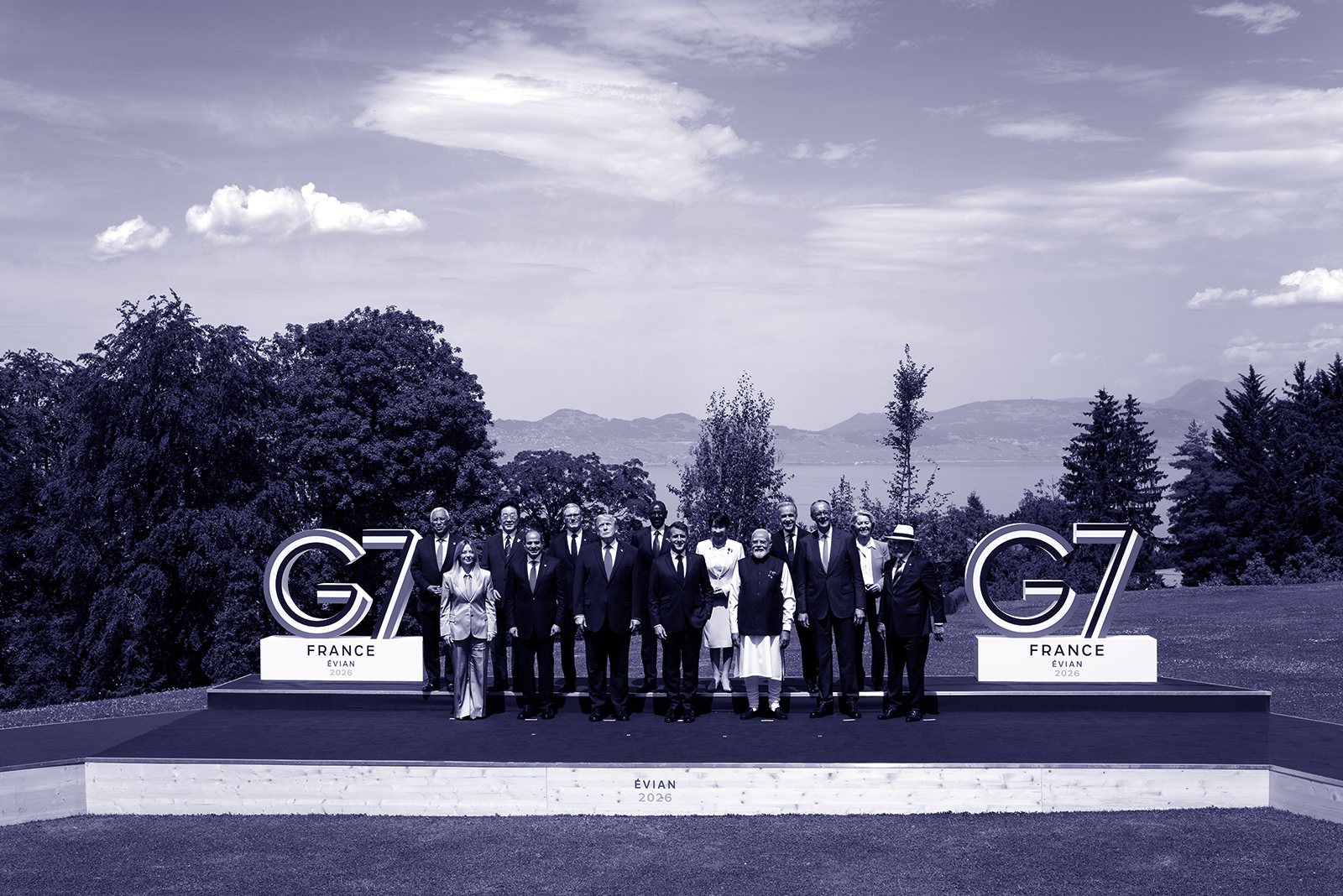
At their Evian Summit in June, G7 leaders made important advances in security, economic, social, and technological issues.
On security, they strongly supported Trump’s 14-point deal with Iran for an immediate ceasefire to the war and the reopening of the Strait of Hormuz, pledging military and financial support. On Ukraine, G7 leaders promised much stronger military supplies and further sanctions on Russia, while in the Indo-Pacific region, they reiterated their commitment to keeping the East and South China Seas and Taiwan Strait open, denuclearizing North Korea, and supporting the Global Convergence for Growth Summit among G7 members and China, which took place a few days prior to the Evian Summit’s start.
On the economy and development, the leaders also promised more financial support for struggling developing countries by mobilizing money from the private sector and the many multilateral and regional development banks that G7 members control. On health, they called for strong and swift action against the new Ebola outbreak in Africa, resolving to mobilize more of their own money, support the UN, and have the US convene a G20 Foreign Ministers’ meeting to do more to address this public health emergency. G7 members and their invited partners of India, Brazil, South Korea, Kenya, and Egypt promised to accelerate their efforts against cancer. They further promised to act aggressively against drug and migrant smuggling. On technology, following their final session held with the heads of major technology firms, they promised to protect children and youth from the AI-intensified harms and threats their social media and devices produce, by having all public and private players contribute to this cause.
All nine leaders – the seven country leaders and the presidents of both the European Council and European Commission – participated in the entire summit. They produced nine declarations, which contained complimentary references to six G7 members and affirmed the G7’s core principles of open democracy and human rights four times. They made 172 commitments, agreed to by all, of which 55% used ambitious terminology that binds the members to action, such as pledges to produce a specific outcome. Among these commitments, 33 were made on development, 30 on critical minerals, 28 on drug smuggling, 19 on geopolitical issues, 18 on cancer, 16 on economic growth, 11 on the Ebola epidemic, 10 on minors’ digital safety, and 7 on migrant smuggling. To help spur implementation, the commitments contained 24 catalysts that specify implementing agents, deadlines, targets, and mandates to report back to the leaders themselves. The leaders created three bodies of G7 officials on drugs and critical minerals, guided G7-dominated or -controlled institutions 25 times – such as through promoting work done by the G7 Infrastructure Investment Council or the Financial Action Task Force – and supported 11 United Nations (UN) and other multilateral organizations 12 times.
This strong performance was propelled by shock-activated vulnerability from the Iran and Russia-Ukraine wars, the Ebola epidemic, AI-generated cyber-insecurity, and new US tariffs – all of which have been met with multilateral organizational failure, especially from the UN, the World Health Organization (WHO), the International Telecommunication Union (ITU), and the World Trade Organization (WTO). Because G7 members have globally influential capabilities and there is balanced burden-sharing among them, leaders demonstrated both capacity and willingness to help close these performance gaps. The very high value held by the leaders for their G7 club at the center of a growing network of global summit governance propelled them to a strong performance by the summit’s end. However, the diminishing cohesion among the G7’s common principles and practices, due in part to Trump’s departure from prevailing norms in addition to leaders’ low domestic popularity, has hindered stronger performance.
THE G20 MIAMI SUMMIT’S G7 ANCHOR
The G7 Evian Summit also served as a firm anchor for the upcoming summit of the broader G20, deliberately designed as such by French President Emmanuel Macron. His invited guests included the large G20 democracies of India and Brazil from the Global South, as well as South Korea and Australia from the Global North. Unlike in Kananaskis in 2025, Trump stayed for the Evian sessions with these guest leaders.
Macron’s guests also included Sheikh Mohamed bin Zayed Al Nahyan, President of the United Arab Emirates (UAE). At the summit table, he thanked G7 and partner leaders for supporting the UAE against Iran’s attacks, called for cooperation on resilient supply chains, secure trade routes, efficient infrastructure, the energy transition, AI, economic development, and innovation. The French President’s Evian priorities of economic imbalances, international partnerships, critical minerals, and minors’ digital safety coincide well with Trump’s Miami priorities of the economy, energy, and technology.
All of the G7 Evian documents, except the statement on geopolitical issues, were explicitly supported by the G7’s invited guests or partners. These guests and partners thus supported the 153 commitments contained in these statements (with the remaining 19 commitments on geopolitical issues supported by the G7 members alone). These guests and invited partners were led by G20 members South Korea, India, Brazil, and Australia, providing 14 G20 endorsements in all. Egypt and the UAE joined India and Brazil to provide ten separate endorsements from BRICS.
More specifically, nine of Evian’s 172 commitments referred explicitly to the G20, and six of these nine (roughly 67%) were ambitious in their reach, such as a pledge to strengthen the implementation of the G20 Common Framework for Debt Treatments. By subject, development had five commitments referring to the G20, economic growth two, and cancer and geopolitical issues each had one. By issue, the commitments were led by references to the G20 Principles for Quality Infrastructure Investment (four references), while the G20 Common Framework, G20 Compact with Africa, G20 foreign ministers, and the G20 in general were each referenced once. Two commitments, both on economic imbalances, explicitly promised to “continue these efforts within the G20 under the United States’ host year.” Altogether, three of the G7 commitments addressed what the US-hosted G20 would tackle in the months ahead.
THE US G7 SUMMIT IN 2027
The Evian G7 and the Miami G20 provide a strategic foundation for the 2027 US presidency of the G7 to shape an agenda focused on targeted agreements over broad multilateral coordination. Trump is likely to prioritize outcomes that can be framed as practical wins for the US – economic prosperity, supply chain resilience, AI deployment, digital infrastructure, expanded fossil fuel production, secure shipping routes, and tough language on Russia’s oil and gas sectors – while scaling back climate change commitments, development assistance, and institutional reform. These priorities reflect Trump’s approach during the Evian Summit and align with his administration’s ‘America First’ framework.
These priorities for 2027 will likely reinforce the view that the US prefers transactional outcomes, bilateral dealmaking, and investment-focused initiatives over extensive summit communiqués. The expectation is that the G7 will serve as a platform for advancing a select few concrete wins that fit Trump’s priorities, rather than building a broader multilateral consensus framework. The probable result is a more selective, strategic, and US-focused agenda.
BRICS AS A COMPLEMENT & CONNECTOR
Since the leaders of Brazil, Russia, India, and China held their first summit in 2009 and were joined by South Africa in 2011, BRICS has evolved into a broader coalition that now includes Egypt, Ethiopia, Indonesia, Iran, and the UAE. With members from the Middle East and North Africa, the grouping increasingly reflects the strategic priorities and tensions of this region.
BRICS is regarded as a counterbalance to the G7, rather than a direct substitute. It provides major emerging economies a platform to advance priorities that receive less direct attention from the G7. Its expanded membership strengthens this role by uniting countries that sit at the intersection of energy markets, investment flows, and geopolitics.
China occupies a central role within BRICS, both politically and strategically, with Beijing widely viewed as the driving force behind the bloc’s expansion and the broader ‘BRICS Plus’ model. As a result, BRICS is increasingly seen as a vehicle for China to advance a model of global governance less centered on the West.
The competition between the G7 and BRICS is very visible in finance. BRICS countries want to reduce their dependence on the US dollar by expanding local currency trade, building new payment systems, and establishing alternative financial institutions. Most of these efforts remain largely aspirational as the G7 still leads in global banking and capital markets.
The BRICS Plus model strengthens the grouping’s global influence but does not necessarily make it more cohesive. Countries, including the UAE, remain deeply integrated into Western financial markets and security partnerships. This means that their membership increases BRICS’ weight in areas such as energy and investment, but does not transform the group into a cohesive rival to the G7.
The 2026 BRICS summit, which will be hosted by India in New Delhi on September 12–13, will focus on AI cooperation, energy security, critical minerals, emerging technologies, and reduced reliance on Western-dominated financial systems. The summit will also test BRICS’ ability to maintain influence as its expanded membership brings greater geopolitical weight but also bigger political and economic differences.
STRENGTHENING THE G7’S CONNECTING CHAINS FOR ALL
Over the longer term, the G7 faces several critical challenges. The first is stopping and preventing wars, particularly across the Middle East, Europe, and the Indo-Pacific region. The second, once Russia’s invasion of Ukraine ends, is reforming, rebuilding, and finally restoring Russia’s participation in the G7 and doing so far more successfully than from 1998 to 2013. The third is containing and collaborating with China on security, AI, critical minerals, energy, and the climate, while the fourth is mitigating the existential threat of climate change.
REFORMING THE G7 FOR STRONGER GLOBAL GOVERNANCE
The G7 has long faced questions about its relevance, mandate, and capacity to adapt to and anchor the new multipolar world. To maintain relevance and effectiveness, the G7 should keep its core membership while allowing a small, targeted expansion based on its members’ mutual consent, a strategic rationale, clear criteria, and the candidate’s potential to effectively contribute to the group’s mission. India currently stands as the strongest candidate, given its size, resilient democracy, and growing role in climate change, clean energy, health, and digital infrastructure.
More inter-sessional G7 summits should be held to deal with emergencies and strategic issues without becoming institutionalized, as the real constraint is consistent implementation of the well-prepared commitments made by leaders at their high-profile annual gatherings. More G7 ministerial meetings should be held each year, as they boost members’ implementation of their commitments and expand the range and contribution of outside guests. Additionally, G7 leaders should meet regularly on the sidelines of G20 meetings, as BRICS leaders do, to coordinate and enhance their leadership within this bigger, broader group containing all the key players in today’s evolving multipolar world.
The statements made and views expressed are solely the responsibility of the authors, and do not represent Fiker Institute. To access the Appendix, download the PDF.