Syria: Shifting Identities & Rewriting the Social Contract
INTRODUCTION
The downfall of the Assad regime on December 8, 2024, closed a painful chapter in Syria’s history, ending more than half a century of Assad family rule which shaped political, social, and economic spheres for all Syrians. From Ba’athification to Assadification,1 the Syrian state revolved around the Assad persona and the country became what was dubbed Souriyya al Assad,2 Assad’s Syria. With the onset of the revolution in March 2011, regime forces adopted the motto al Assad aw nahreq al balad, “either Assad or we will burn the country.”3 Indeed, over the course of the 13-year conflict, this motto became a reality. Assad forces killed more than 500,000 people,4 displaced roughly half of the Syrian population,5 and transformed the country into a battleground for various state and non-state actors. This validated the assumption that ousting the regime was nearly impossible without sinking the country into chaos and bloodshed.
Yet, the swift fall of Assad’s rule proved these assumptions wrong. On the night of December 8, rebels marched to the presidential palace with no confrontation from regime forces. Pictures of Syrians, young and old, pouring into the presidential complex overlooking Damascus looked surreal and instilled hope that the post-Assad era would not be as violent as imagined.6 Justifiably, however, fears of uncertainty remained.
Some 20 months after the fall of Assad, the country is undergoing massive transformations at all levels – political, social, and economic – which will reshape the lives of Syrian people for years to come. Although the picture today looks far from optimal, there have been many concrete achievements in foreign policy and diplomacy. Syria’s new leaders have succeeded in transforming the country’s relations with great powers from enmity to amity in a relatively short period. Since assuming office, Ahmed al-Sharaa has already paid visits to the White House, 10 Downing Street, the Élysée Palace, and the Kremlin. Pragmatism appears to be the modus operandi of Syria’s new president. However, the on-the-ground situation is not as promising as the country’s foreign policy. The new government faces many domestic challenges which, if not decisively addressed, will prevent foreign policy successes from bearing fruit.
Like any other country recovering from conflict, Syria is in a transitional phase on the path to achieving the goals of peace and prosperity. However, the state- and nation-building transitions need to be equitable. Given the combined legacies of colonialism, authoritarianism, and a decade of civil war, this is a formidable task.
Since the establishment of modern-day Syria in 1946 after independence from the French occupation, the country’s leaders have grappled with questions of identity as state-building efforts transformed into regime-building projects.7 At every major historical juncture in Syria’s history – 1946 (independence), 1963 (the start of Ba’ath Party rule), and 2024 (the end of Assad rule) – the issues of state- and regime-building were left unsolved.
This Essay focuses on the current government’s rhetoric on identity formation and the reconstruction of the social contract and examines how these challenges might further complicate the dynamic processes of nation-, state-, and regime-building. As there is no single theory that completely captures the complexity of the Syrian case, this Essay adopts a multifaceted approach, making use of Constructivist ideas and identity theories. The first section examines identity formation, while the second deals with state-society relations.
THE (IM)BALANCE OF IDENTITY IN SYRIA
Identity formation is part of nation-building and constitutes a crucial aspect of post-conflict reconstruction in divided societies that have suffered years of fragmentation. In Syria, where a collective memory of violence exists among different identity groups – including Alawites, Sunnis, Kurds, and Arabs – it is imperative to address persisting issues of identity.
Identity is a paradoxical concept; it can simultaneously be a source of stability and instability, violence and tolerance, and unity and division. Identity is what distinguishes an individual from others, as it “is profoundly influenced by the actor’s interaction with and relationship to others.”8 In academia, identity does not have one single definition: it encompasses an individual’s affiliations with a place, state, class, religion, or tribe, each of which are considered layers of identity that do not override one another. Rather, these different layers “can be integrated in a relatively harmonious way”9 and function peacefully, but they nevertheless may contradict one another and provoke identity clashes as a result. Therefore, balancing different layers of identity is crucial to achieving sustainable peace.
Throughout Syria’s history, the three main identities between which balance has been sought have been Arabism, Islamism, and Syrianism. These identities have competed for power at various political moments, with regional events shaping which particular identity dominated the others.10
When Hafez al-Assad seized power in 1970 (officially becoming president in March 1971), he struck a balance which elevated Arab nationalism as a supra-state identity to which Syrianism and Islamism were subordinated. This identity balancing act aimed for legitimacy and regime survival and functioned for 40 years. Its eventual disintegration – arguably one of the triggers of the 2011 uprisings11 – owed to its contradictory nature, as it adopted a secular Arab nationalist ideology while at the same time operating on the favoritism and empowerment of members of the Alawite sect.12 Indeed, Hafez al-Assad relied on assabiya (Ibn Khaldoun’s theory of group solidarity) in regime-building by “favoring [Alawite] kin in recruitment, and most significant in admission to the officer corps.”13 Thus, competing religious and secular nationalist identities were simultaneously accorded prominence, a formula for Assad regime-building.
As the 2011 uprisings transformed into a protracted, violent armed conflict, Islamist and Syrianist identities dominated over Arab nationalist narratives. For the first time in Syria’s modern history, the regime’s rhetoric focused on Syria first – Syria not as part of the Arab world, but as the basis for a separate, unique identity in its own right. Simultaneously, multiple versions of Islamic identity, varying from moderate to radical, were enforced by armed opposition groups.14
In the post-Assad era, the identity balance struggle persists. The military victory by a particular identity group (Sunni) swung the balance again and gave momentum to Islamism. Arab Nationalism has faded away as a supra-state identity and other substate identities – Alawite, Druze, Christian, and Kurdish – compete for influence. Each identity group fears the domination of the other, which has led to violent clashes. Such clashes occurred between Sunnis and Alawites in Syria’s coastal areas in March of last year15 and in Sweida between Sunnis and the Druze community in July of last year.16
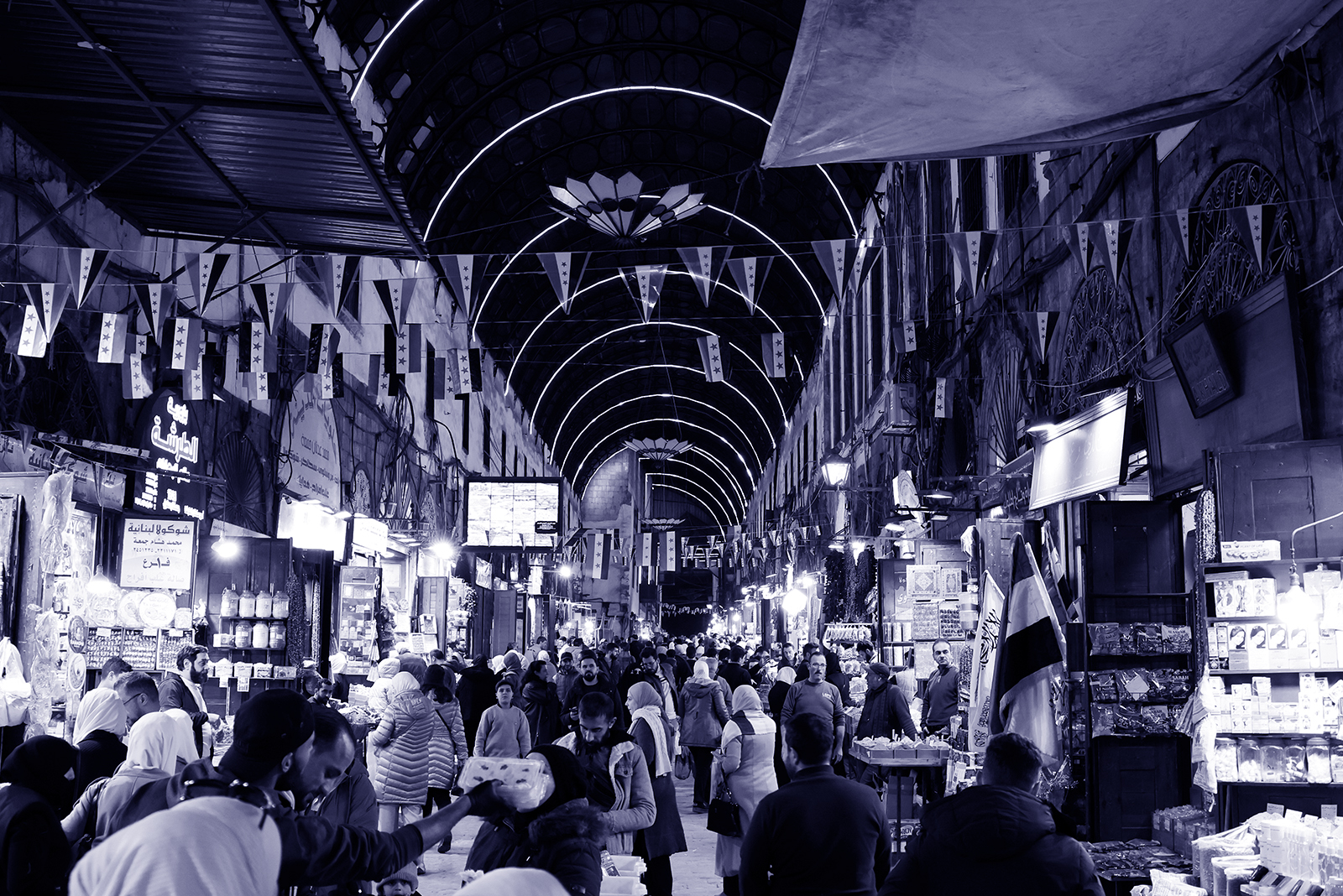
Interestingly, such identity clashes are not limited to physical violence, but encompass a war of symbols as well, with each group invoking history and symbols of the past to weaponize identity. At the grassroots, many Sunnis refer to themselves as grandsons of Bani Umayya,17 the Umayyads, invoking the era in which Damascus was the capital of the Caliphate. Remarkably, Druze leader Hikmat al-Hijri referred to the mountain generally called Jabal al-Druze or Jabal al-Arab as Mount Bashan, a biblical name invoking myth and history.18 By the same token, shortly after the fall of Assad, Christians demonstrated in the old city of Damascus chanting “oh Jesus, we are your soldiers,” protesting the burning of a Christmas tree in Hama.19 All these religious identities were once subsumed under Arab nationalism, but as a result of this ideology’s demise, they have now turned to compete against each other.
Discourse by the current government has explicitly emphasized national unity and repeatedly stated that the goal is Souriyya wahida muwahhada,20 one united Syria. Implicitly, however, there seems to be a tendency toward reinforcing an Islamic identity that aims to merge Islamism into Syrianism both materially – using arms, media, education, and currency – and symbolically, through flags and the invocation of history. Both are crucial in constructing identities.
SHAPING NARRATIVES THROUGH ARMS, EDUCATION & CURRENCY
The newly established Syrian army consists of soldiers who were previously members of different Islamist militias.21, 22 The military forces therefore tend to emphasize their Islamic identity. In February 2026, the government held a military graduation ceremony in Aleppo with the motto that the army should be grounded in both military strength and in iman (faith) to honor soldiers who memorized the Quran after completing a religious studies program.23
In the same context, there is an attempt to infuse school curricula with an Islamic worldview. Although the same official curricula of the Assad era are in use (albeit with the removal of the previous regime’s symbols), the Ministry of Education has ordered the removal of national events, figures, and images of their statues,24 as well as references to the pre-Islamic era. Phrases like “defending the nation” have additionally been replaced with “defending Allah.”25 Furthermore, the largely negative framing of the Ottoman era in Syria as an atrocity and an occupation has shifted to a more neutral characterization calling it Ottoman “rule,”26 a significant shift in the historical narrative. Jamal Pasha, an Ottoman autocratic figure who ordered the execution of Syrian nationalists and was previously described as Jamal Pasha al-Saffah (“the Butcher”) in the curriculum, is now mentioned without this epithet, referred to simply as Jamal Pasha.27
The current government has also cancelled official holidays including Martyrs’ Day, which was traditionally commemorated on May 6 to honor the nationalist figures executed in Beirut and Damascus on the same day in 1916 by Jamal Pasha.28 This is an attempt to reshape collective memory and historical narratives, thereby constructing a particular version of national identity that depends on the new political reality.
Currency – which carries political messages reflecting a country’s ideological orientation at any given historical moment29 – has also been utilized by the current government to reproduce a particular version of identity. In December 2025, the government was reported to have issued a new banknote in which portraits of the Assad family were removed.30 However, the generic images of Mediterranean fruit and floral motifs with which Bashar al-Assad’s portraits have been replaced fail to capture Syria’s centuries-old history and its rich cultural identity: a history further erased by the removal of figures like Queen Zenobia and the pre-Islamic goddess Ishtar as well as landmarks like the Roman theater at Bosra.31 The marked absence of any national historical symbols constitutes a deliberate attempt to flatten Syria’s identity and sideline its history.
Evidently, the identity balance in Syria is still in flux, with Islamism appearing to eclipse Syrianism. This approach is not inclusive and will not build social cohesion nor help foster nation-building.
STATE-SOCIETY RELATIONS: A PERPETUAL CYCLE OF MISTRUST
State-society relations lie at the heart of state-building. They are formed through a structured institutional process that evolves through the “interactions between state institutions and societal groups to negotiate how public authority is exercised and how it can be influenced by people […] Strong state–society relations underpin effective states and durable, positive peace.”32
One key concept in social science that is central to state-society relations is the social contract, which denotes the (unwritten) agreements between a given authority and the various groups in society on how to define rights and duties.33 The social contract encompasses a set of “processes by which everyone in a political community, either explicitly or tacitly, consents to state authority, thereby limiting some of her or his freedoms, in exchange for the state’s protection of their universal human rights and security and for the adequate provision of public goods and services.”34 Hence, the social contract is responsible for shaping and maintaining state-society relations by balancing power and legitimacy.
Many scholars and experts of the region argue that the breakdown of social contracts served as the main trigger for the so-called Arab Spring.35 Their assessments are convincing, especially when it comes to the Syrian case, in which the social contract was subjected to different transformations that eventually led to its collapse.
In the 1970s, Hafez al-Assad established a populist authoritarian social contract that delivered security and limited resources – mainly day-to-day services – without inclusive political representation.36 The neoliberal policies that were adopted by his successor Bashar two decades later transformed the Ba’athist social contract.37 During the first 11 years of Bashar’s rule, the social contract provided neither economic resources nor political representation, and indeed completely broke down with the onset of the uprisings as the state failed to deliver security, political representation, and basic resources.38
After the toppling of the Assad regime, various factors make the current social contract in Syria highly vulnerable, notably the weakness of state institutions and deepening divisions among societal groups. Although, unlike in Iraq and Libya, state institutions did not completely collapse with the fall of the regime, they remain weak, non-inclusive, and suffer from an excessive concentration of power. In addition, various factions of Syrian society remain trapped in a cycle of mistrust, which periodically triggers violent clashes such as those which took place in Sweida and in the country’s coastal regions.
When it comes to (re-)constructing the social contract, it is therefore crucial to look at two important relevant concepts: the social covenant and social cohesion. The social covenant refers to the peaceful interaction between members of various groups and their agreements on how to co-exist peacefully.39 Social cohesion denotes the strengthening of solidarity within a given society and “the reduction of disparities, inequalities, and social exclusion within or between societal groups.”40
Looking at the Syrian case, one can argue that it lacks both a social covenant and social cohesion. Indeed, there are deepening divisions among the various social (urban/rural), religious (Christian/Muslim), sectarian (Druze/Alawite/Sunni), and ethnic (Kurd/Arab) groups. While this is to some extent to be expected in a post-conflict situation with a legacy of authoritarianism and a collective memory of political violence, the current government seems to be doing little to address these issues.
CONCLUSION
Political transitions are long and multifaceted processes that require building social cohesion and empowering state institutions. While there appears to be a window of opportunity for Syria’s new political leadership given its unprecedented degree of international support, this window is finite. The support and legitimacy that the government should be prioritizing are those given by the Syrian people. Rebuilding the social contract and achieving balance between the country’s multiple identities are both necessary for a sustainable transition toward stability, and hopefully, democracy.
There is a huge billboard in a central square in the city of Idlib, the foothold of the rebels who became Syria’s rulers, bearing the words Souriyya al-jadida li-l-kull, “the new Syria is for all [Syrians].”41 Paradoxically, a huge Salafist flag can be seen standing just next to the billboard, reflecting the contradictory nature of the rhetoric dominating Syria today.
Identity formation is a key issue that has been left unaddressed in Syria for decades. The question of ‘who are we?’ – Syrians, Arabs, Ba’athists, or Muslims – has haunted Syrians for generations. However, identity balance should not be weaponized as a tool for hegemony, and more importantly, it should not be grounded in ideologies, which rise and fall at different points in history. Instead, civil rule and a civic identity embedded within a national identity offer a more inclusive and sustainable foundation for maintaining that balance.
In July 2026, portraits of the late Iraqi president Saddam Hussein were a frequent sight in the streets of the old city of Damascus.42 Hussein, once celebrated among Syrians as an Arabist and Ba’athist, is now praised as a Sunni figure in a very different political context, reflecting how fluid and unstable identities – and their instrumentalization – can be.
What Syria’s new leaders should focus their efforts on is rebuilding trust among the country’s various identity groups on the one hand, and between society and state on the other. They should also bear in mind that relying on a new political reality for survival is insufficient, because alliances shift radically, and so does identity.
The statements made and views expressed are solely the responsibility of the author, and do not represent Fiker Institute. To access the endnotes, download the PDF.