Pakistan’s Moment in the Middle: Mediator, Messenger, or Maneuverer?
Rather than solely a cessation of hostilities between Iran and the United States (US), the two-week ceasefire between the two parties, brokered by Pakistan, is an attempt to establish a framework for mediating a wide range of issues in the Middle East. Since its declaration, however, it has been extended, continuously contested, and brought close to collapse. Tehran and Washington remain in a formal state of war: diplomatic missions in each other’s capitals are shuttered and the Strait of Hormuz continues to be an arena of active dispute. What the ceasefire has produced, however, is a revealing diplomatic subplot, that of Pakistan’s emergence as the principal channel through which messages are being transmitted across one of the most volatile fault lines in contemporary international relations.
As of May 2026, the situation remains unresolved. The first formal round of talks in Islamabad on 11–12 April was a 21-hour marathon led by Iranian Parliamentary Speaker Ghalibaf and US Vice President Vance. It ended without agreement, with the parties deadlocked over the Strait of Hormuz and Iran’s nuclear program. A planned second round collapsed on 25 April when Iran’s Foreign Minister Araghchi left Islamabad and US President Trump cancelled the US delegation’s travel. Pakistan’s role as venue, channel, and diplomatic cushion therefore continues, but its limitations are growing starker. What kind of mediator is Pakistan in the current crisis, and what does its role reveal about the regional order that may be taking shape around it?
A MEDIATING ARCHITECT OR MESSENGER?
Pakistan has passed messages between Tehran and Washington, hosted regional powers seeking de-escalation, and provided a venue for formal negotiations. This remains a critical function, but Islamabad is closer to a trusted messenger than an architect of conflict resolution. The distinction is not pejorative. Effective message-carrying requires a state to understand not only what is being said, but also what lies behind each statement transmitted.
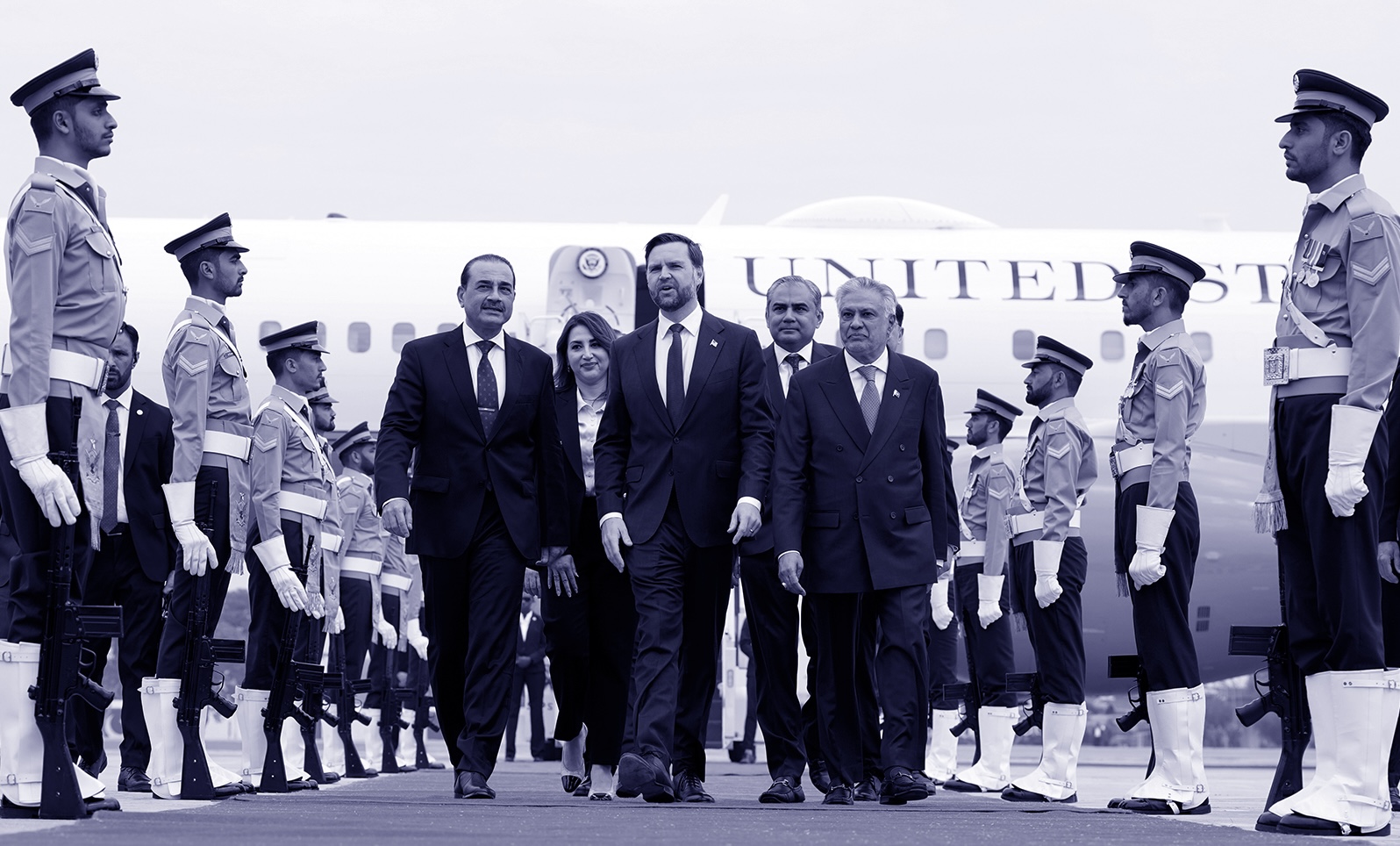
Islamabad was central to the push for the initial ceasefire and has since hosted the most significant direct talks of the conflict. On 11–12 April, the Islamabad talks brought together a 300-member US delegation and a 70-member Iranian delegation, marking the first direct engagement at this scale. Pakistan’s mediating team, led by Prime Minister Sharif, Field Marshal Munir, and Foreign Minister Dar, moderated three rounds over 21 hours. The talks ended without a consensus on the main items in the mediation file. Within 24 hours, Trump imposed a naval blockade on Iranian ports.
Disputes surrounding the ceasefire had already revealed the limits of Pakistan’s authority. One of the main differences between Iran and the US was the inclusion of Lebanon in the ceasefire framework. Tehran and Islamabad claimed the ceasefire covered it, yet the US and Israel denied it did. This was far from a marginal misunderstanding or misinterpretation as it was a key prerequisite for the Iranian delegation to proceed with the rest of the negotiations. It shows that Pakistan’s role as mediator does not extend to authoring the terms of the ceasefire. What Islamabad endorses carries weight only to the extent that Iran and the US choose to respect it. The Lebanon dispute also exposes a deeper structural problem: Israel, which continues to conduct strikes across Lebanon and is not bound by the ceasefire terms in the US-Iran track, has no diplomatic relations with Pakistan. Pakistan struggles to address disputes that include a party with whom it has no official channels at all. This is not a peripheral limitation, it is a ceiling on what any ceasefire brokered through Islamabad can achieve in practice, as much as the US presence absorbs some of these limitations.
After the second round of talks collapsed, Pakistan intensified its efforts to bring both sides back to the table. Pakistani authorities framed the engagement as a broader ‘Islamabad process,’ understood as an ongoing diplomatic track rather than a single event. Trump unilaterally extended the ceasefire on 21 April at Pakistan’s explicit request, after PM Sharif and Army Chief Munir asked him to delay renewed strikes while Iran worked toward “a unified proposal.” That extension, which Iran dismissed as “meaningless” given the continuing naval blockade, nevertheless demonstrated Pakistan’s residual leverage. Islamabad may not have the power to impose outcomes on the parties, but it does evidently continue to have some credibility when it comes to requesting pauses.
A second round scheduled for 25 April failed before it began. Pakistan remains in contact with both sides, bilaterally. As of now, the situation is a stalemate, and a second round of talks has been suspended indefinitely.
THE ROLE OF PAKISTAN-CHINA RELATIONS
Islamabad’s prominence must also consider its relationship with China and the fact that Beijing maintains considerable influence in Tehran. Through energy linkages, sanctions-era cooperation, and sustained diplomatic engagement, China’s engagement in Iran is unique, yet Beijing is keen to avoid appearing as having a role as the architect of any arrangement between Tehran and Washington. Here, Pakistan offers a useful lower-profile channel that is open to influence and suggestions for pathways, enabling Beijing to continue to shape the broader diplomatic environment at a distance. Through Islamabad, messages could be tested and intentions signaled.
As China’s closest strategic partner and a country long embedded in the China-Pakistan Economic Corridor (CPEC) — a framework through which China has extended infrastructure investment and economic dependency across Pakistan to a degree that constrains Islamabad’s autonomous foreign policy choices — Pakistan may have functioned as a useful extension of Chinese outreach. At the core of this is the joint Pakistan-China statement of 31 March, which advanced a five-point framework for ending the war and implicitly underscored the constraints on Pakistan’s ability to mediate independently. It also pointed to the extent to which Islamabad’s diplomatic role required the backing, or at least the strategic anchoring, of a major global power.
CONCLUSION
The trajectory since the ceasefire announcement on 8 April illustrates both the value and the ceiling of what Pakistan can do. It secured the initial ceasefire. It hosted the only direct talks between the US and Iran, which may not have led to a deal but did establish a framework of negotiations and demands. And it continues to serve as the primary communication line between parties. These are not trivial accomplishments.
The present stalemate, however, makes equally clear what Pakistan cannot do. With the naval blockade in place and the second round of talks suspended before it began, Islamabad cannot bridge the gap between an American demand for complete Iranian nuclear disarmament and an Iranian insistence on enrichment rights. It cannot lift a blockade, nor can it compel either party to accept the other’s terms. Its leverage is access, not coercion. Moreover, it cannot guarantee the terms agreed. Pakistan’s channel runs to the civilian tier in Tehran — to President Pezeshkian and Foreign Minister Araghchi — not to the Islamic Revolutionary Guard Corps, which holds the decisive levers of military decision-making. Any agreement that Pakistan facilitates therefore lacks sign-off from one of the main actors with the capacity to enforce or violate it. This is a structural constraint that no amount of Pakistani credibility can overcome.
A new regional order is emerging. Even if active hostilities subside and maritime passage through the Strait of Hormuz is restored, the Middle East appears to be entering a phase marked by deeper militarization, denser strategic interdependence, and heightened exposure to recurrent crises. In this environment, questions surrounding Gulf security, Iran’s nuclear threshold status, Israel’s operational latitude, the durability of the US regional military posture, and the diplomatic utility of middle-power mediation are likely to be contested and recalibrated at the same time. The ceasefire is not a settlement, but rather a thin, transactional framework dependent on continued mediation and heavily conditioned by unresolved disputes over the Strait, constraining US engagement in the Middle East, the Lebanese theater of conflict, and the nuclear file. Pakistan is not mediating and negotiating a cessation of hostilities, but rather a framework of conflict resolution mechanisms and channels, established red lines, and strategic understandings between Iran and the US outside the current theater of the war, and across other current and future crises and conflicts in the region. Pakistan’s role in shaping the region and sustaining peace is therefore minimal, but what Pakistan can do and sustain is the mediation channel itself. For now, that channel remains the most functional diplomatic instrument in a conflict and region that has exhausted most other options.
Pakistan’s contribution is therefore real, limited, and revealing, all at once.
The statements made and views expressed are solely the responsibility of the author, and do not represent Fiker Institute.