On Fahrelnissa Zeid: Expression Beyond Time & Space
INTRODUCTION
Although Fahrelnissa Zeid spent her life living and working in Türkiye, Europe, and Jordan, she did not see herself as belonging to any particular nation or faith.1 Instead, she understood her identity as an artist in universal terms, saying that she belonged “neither to a country, nor to a religion. I was born on this earth. I am made of this matter, and everything that relates to it interests me.”2 Her art and career were like no other. A painter of light and motion, her baroquely expressionist works – both abstract and figurative – demonstrate a rare command of exalted gestures and minute motifs. One of the major artists of the 20th century, her “large paintings remain unrivalled in their ambitious scale by any woman artist until Joan Mitchell[’s…] 1960s triptychs.”3
Her art and her turbulent life, spanning different countries, give her a unique place in the history of modernism before the reality of globalization. She was the first artist from the Middle East to have a prominent and sustained career in several art capitals, including being the first to exhibit in a New York commercial gallery, in 1950.4 She made history in July 19545 as the first female artist of any nationality to present a solo exhibition at the Institute of Contemporary Arts, London’s leading modernist exhibition space.6
With her drive, Zeid managed to integrate two modernist art movements from different continents and time periods. Her art cuts across time periods and styles, for no work of hers is easily dated to a given fashion or trend. She produced such an atemporal corpus because her practice was driven by a quasi-spiritual compulsion expressed through light and color. This is perhaps best reflected in her 1960s works which she called Paléokrystalos7: colored transparent polyester resin blocs, encasing small poultry bones forming a range of patterns, displayed on backlit revolving stands. Fahrelnissa Zeid’s multimedia oeuvre reflects her conception of art as a constant quest forward, driven by a need to express in painting her inner psychic universe and her lifelong fascination with the cosmos.
LIFE & CAREER
A Turkish noblewoman by birth, an Iraqi princess by marriage, an ambitious artist, a mother, an art teacher in her eighties, Fahrelnissa Zeid led multiple lives. Despite her privileged circumstances, she overcame illnesses, tragedies, as well as gender and orientalist prejudice, to chart a unique and innovative artistic path.
The young Fahrinnissa Şakir Kabaağaçlı grew up at the dawn of the 20th century in the Westernizing waning Ottoman Empire. She was a personification of European ‘high culture’ with her connoisseurship and reverence for the European Old Masters, her passion for Romantic and Neo-Romantic classical music, and her absorption of the French literary canon. She went on to become one of the first students at the new Istanbul women’s fine arts academy in 1919.8 In the 1920s, she traveled throughout Europe with her modernist writer husband İzzet Melih Devrim (1887-1966), visiting major museums and making copious sketches.9
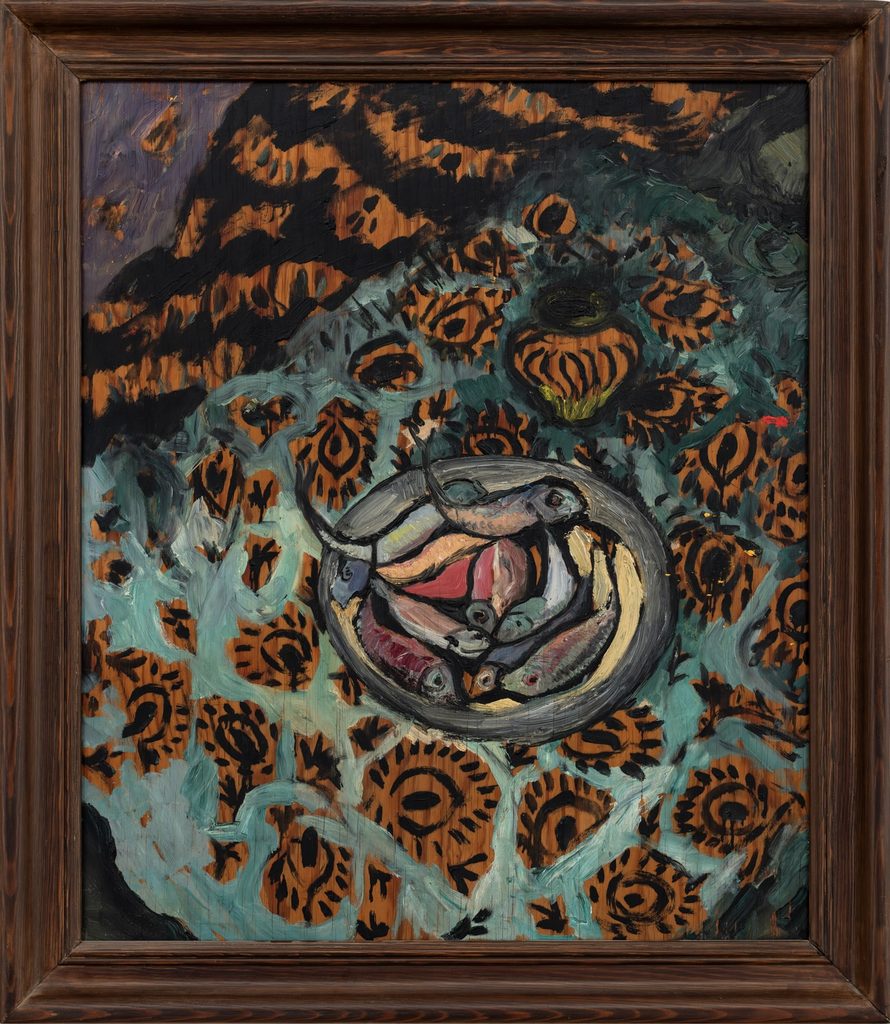
Her shift towards modernism came on one of those trips, with her 1928 enrollment for a few months at the Académie Ranson in Paris, where she was most impressed by her instructor, the cubist painter Roger Bissière (1886-1964).10 She abandoned her classicist figurative practice and turned towards figurative expressionism, painting in a studio in her Istanbul home and exhibiting in a few group shows.
Following her divorce from her first husband, with whom she had three children, she married Iraqi diplomat Prince Zeid bin Hussein (1898-1970) in 1933 and Arabized her name. In the following years, she had a fourth child and experienced several mental and physical health breakdowns that led her to hospitalizations,11 where doctors consistently encouraged her to concentrate on her art as part of her recovery.12 She later credited painting as her lifeline through these tumultuous experiences.13 She lived in Berlin, where her husband was posted, for three years and spent time between Paris, Baghdad, and Budapest. In Berlin, she visited German art museums and took painting lessons. Returning to Istanbul during World War II, she painted expressionist cityscapes, busy flat perspective interiors in saturated colors, nudes, symbolist tableaux, and portraits. The next turning point in her career was 1941, when she met Turkish avant-garde painters and intellectuals in Istanbul and became the only Turkish female member of their fourth-generation Turkish visual artists’ group the D Grubu.14 She exhibited with them in Türkiye and Europe, while also holding a number of solo exhibitions from 1945 onwards in Istanbul and Izmir.
In 1946, she followed her husband to London where he had been posted and quickly secured a number of solo exhibitions at prominent local art galleries. She began exploring abstraction gradually between 1947 and 1948, eventually making it the central focus of her practice in 1949. This shift followed a profound experience during her first flight across continents.15 She experienced from her airplane window the vertiginous speed of the change of scale and perspective, as the landscape receded into a riot of multicolored parcels of agricultural fields. Later that year, at her first Paris exhibition, she met art critic and organizer Charles Estienne (1908-1966). He invited her into the constellation of lyrical abstraction artists he promoted, and she became a prominent member of the Nouvelle École de Paris, taking part in its first exhibition in 1952. Her originally ambitious works “eclipsed those of […] her male counterparts.”16 She began to live part-time in Paris and exhibited frequently at the modernist international Salon des Réalités Nouvelles. In parallel, she continued to hold solo exhibitions in London and was invited to exhibit at the Institute of Contemporary Arts in 1954.17
After the 1958 republican coup in Iraq, Fahrelnissa Zeid lived in exile in Europe. The trauma of losing her husband’s family (who were killed after the coup) and former life led her to suspend her practice, until she returned to it via coloring poultry bones and carcasses in her kitchen, leftovers from home-cooked meals. She gradually reprised her abstract painting and in the 1960s, returned to figuration via portraiture. In the meanwhile, she was inventing the unique art form of Paléokrystalos, which she developed after her colored poultry bones were appreciated by famed French writer and Minister of Cultural Affairs André Malraux.18 She continued exhibiting at major Parisian venues run by prominent women gallerists of the time such as Dina Vierny19 and Katia Granoff.20
In 1975, she left Paris for Jordan to join her son and his family and began teaching art in Amman. Her teaching and exhibitions with her students helped validate abstract art in Jordan. A highlight of her work in Amman was a massive 1981 group exhibit, held in a cultural center theater with its seats removed as no gallery in the city could accommodate her large paintings and those of her students, which she showed in equality alongside her own.21
From the mid-1980s, Fahrelnissa Zeid returned to exhibit her work in Türkiye and Europe, including at the Neue Galerie-Sammlung Ludwig in Germany and at Paris’ Institut du Monde Arabe.22 Her works have been posthumously exhibited in many countries, including in a centenary exhibition at Amman’s Darat al Funun Foundation,23 founded by her former student, artist Suha Shoman (1944-), and 2017 retrospectives at Tate Modern and at Deutsche Bank KunstHalle in Berlin.24
Her works are held by major collections and museums internationally and continue to break record prices for female and Middle Eastern artists at auctions in the Middle East, Türkiye, and Europe.25,26
ART
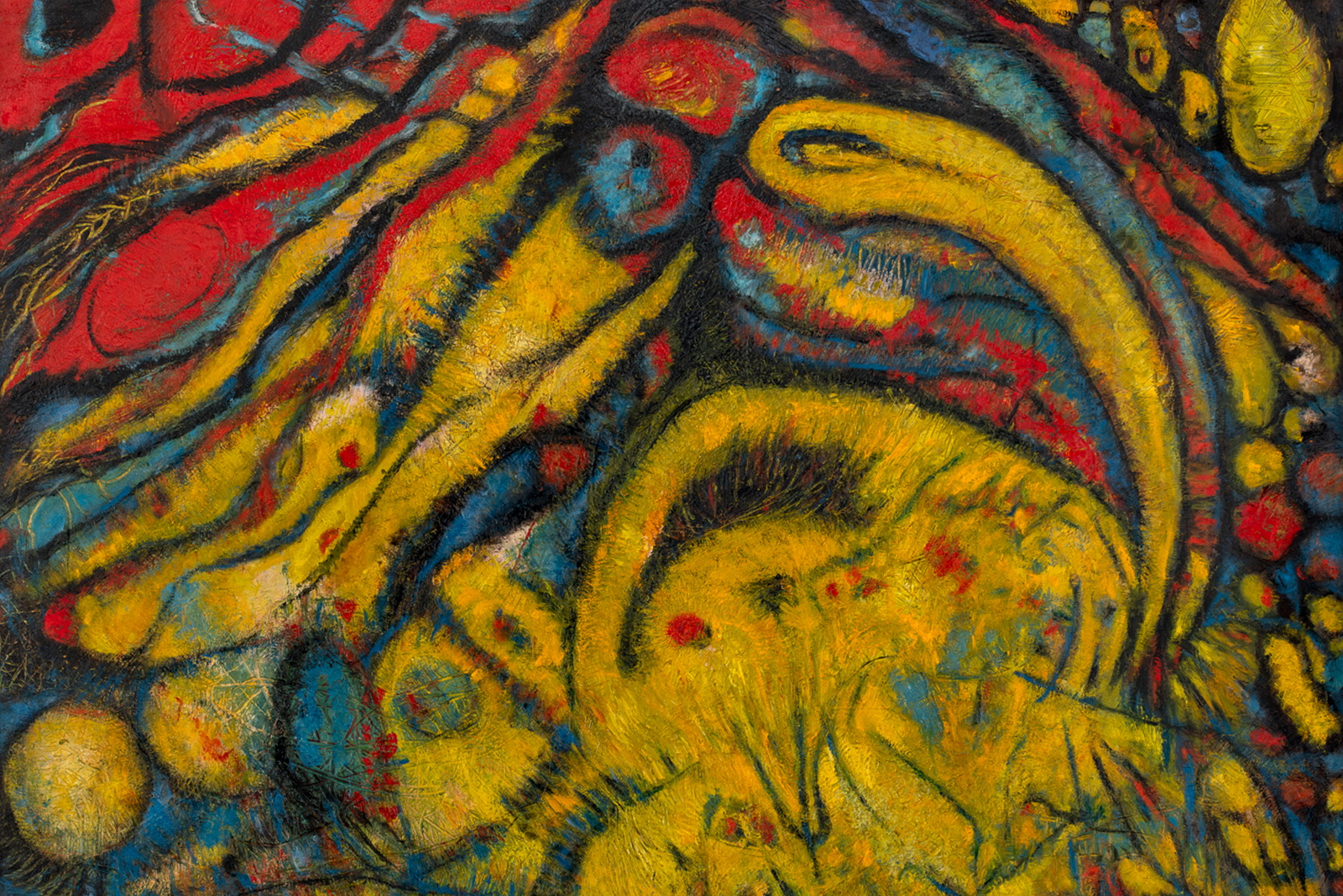
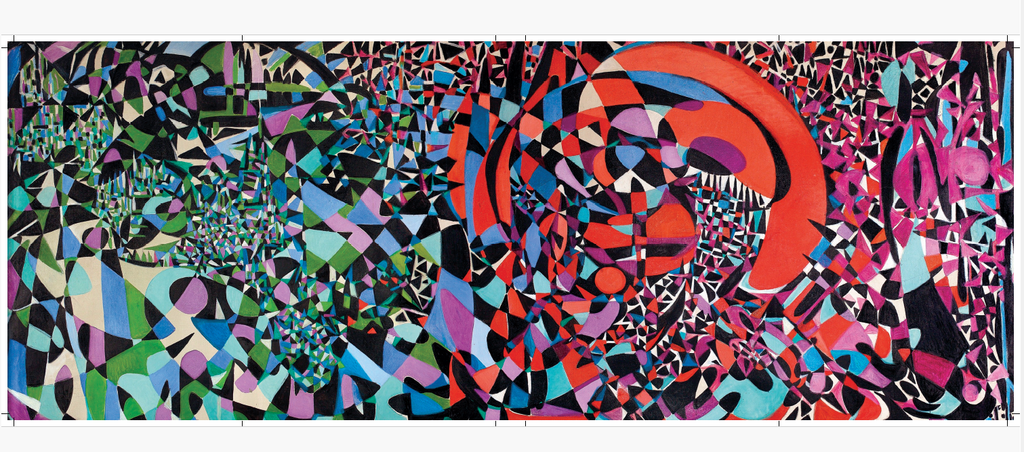
Fahrelnissa masterfully deployed color, line, and notions of the sublime and the infinitesimal in a five-decade-long career, producing an extraordinary body of work. She is known today for her large chromoluminarist abstract compositions and for her hieratic portraits. In fact, her oeuvre spans so many stylistic directions and explorations with different media that it may be mistaken for the output of several artists, rather than of one individual whose career began late in life, and whose biography was beset by upheavals. Fahrelnissa Zeid’s single-mindedness allowed her to develop a consistently innovative output and to overcome her shifting moods and states of energy. She was able to work rapidly and create abstract monumental works that contemporary artists execute via projected computer software-generated patterns. She often created by first designing the pattern with charcoal on the canvas, then filling it with paint over hours and days of uninterrupted focus.
At the same time, her hypomania afforded her an awareness of cognitive realms outside the prosaic perceptual frames of the here and now. She described it as feeling the vibrations of the universe, as transposing in her paintings cosmic forces that traverse our world.27 This awareness led her to identify with the writings of Carl Jung and Wassily Kandinsky. She found in the latter’s writings Concerning the Spiritual in Art a conceptualization of her long-held thoughts on art as a spiritual quest of fusion with the universe, and of painting as an “inner necessity.”28
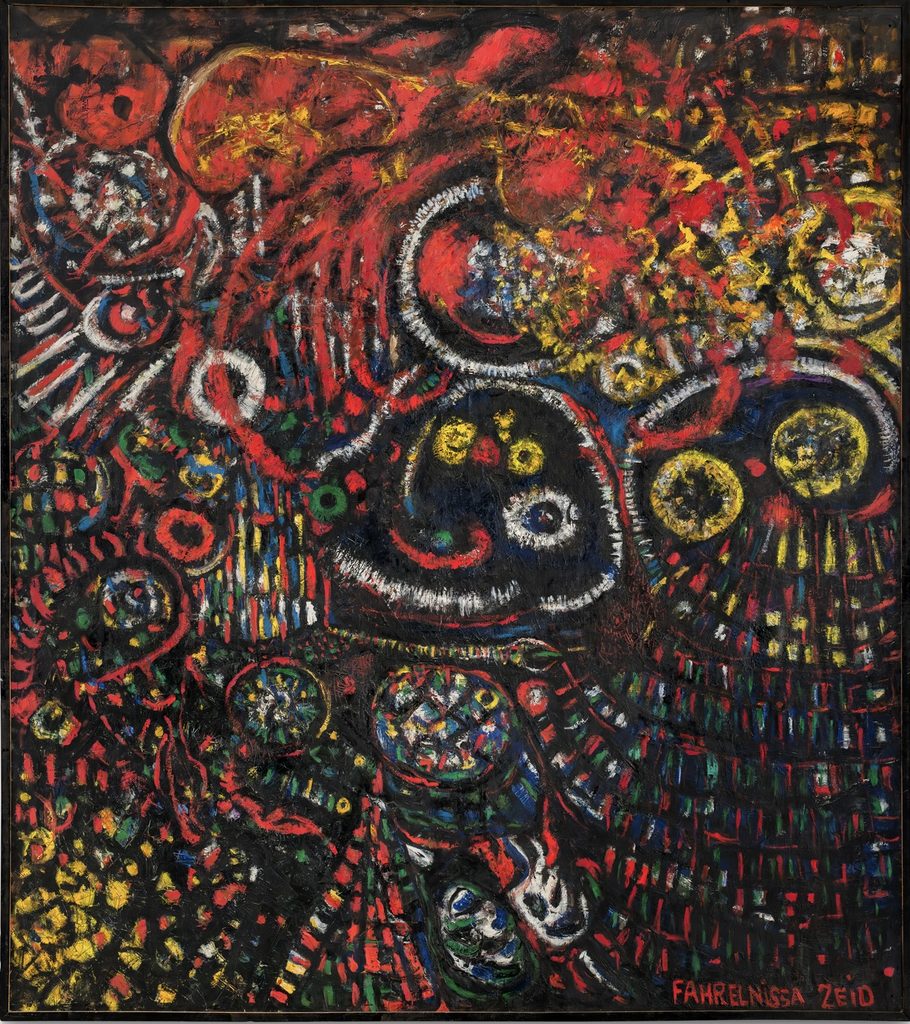
Between her perception of unseen cosmic realms and their transposition onto the canvas, there is a recognizable ‘Fahrelnissa gesture.’ Her paintings are characterized by a high degree of painterliness, while also extensively exploring the notion of linearity. Her ‘hand’ is identifiable in the landscapes and portraits she drew in her sketchbooks, in her interiors and outdoor scenes of the 1940s, in her expansive gestural 1950s canvases, and in her later portraits. That gesture is at the origin of the lines that traverse Fahrelnissa’s compositions: sharp, rapid, thrusting lines that crisscross and swarm the pictorial plane. In her highly saturated colored works, the rapid line is present in a multiplicity of divisionist tangles and bursts. Color fills their recesses when it is not superimposed. In her 1960s-70s portraits, large visages painted with color-field minimalism are repeatedly incised by her palette knife to form wefts and radiating furrows.
Zeid began her professional career as an expressionist figurative painter of thick impastos and short brushstrokes. Some of her works from the mid-1940s mix figurative portentous symbolism with busy motifs, while others are expressionist portraits and self-portraits. Some of her most striking works are sunny landscapes and seascapes that show quick brushstrokes, luminous color, and dynamism that make rolling waves and breezes palpable. That same dynamism, apparent in assured brushstrokes manipulating primary color contrasts contoured by thick black lines, is also evident in the flat perspective detailed renditions of her domestic interiors. Her paintings, regardless of conditions of execution and subject matter, were foremost the result of her boundless physical energy and intense focus.
After Fahrelnissa Zeid settled into abstraction from 1949 to 1969, she developed and then grew out of several styles in quick and overlapping succession. She had six broad phases, starting with an experimental abstract period of aerial views geometries around 1949, such as Voyage of the Man Moon and Abstraction (mis-attributed to 1947). After growing more assured, she moved to her well-known monumental murmurations of which the prime specimens are My Hell (1951) and Towards a Sky (1953). She then transitioned to a maritime, sun-dappled phase of optimistic large works like Intermittence… Sand… Water… Sun (Riviera) (1953)29 and Sargasso Sea (1953),30 bearing the imprint of her Mediterranean summers. She then reinvented herself in two shorter periods, executed on smaller canvases. These ranged from the primitivist nightmarish to the menacing dark, such as Alice in Wonderland (1955) and Les Gauloises (1954). This was followed by a period in 1956-57 characterized by dark, expressive paintings, showing large swaths of intense color bleeding into other darker colors on small canvases and sometimes bearing mysterious grids like The Red City (1957).31
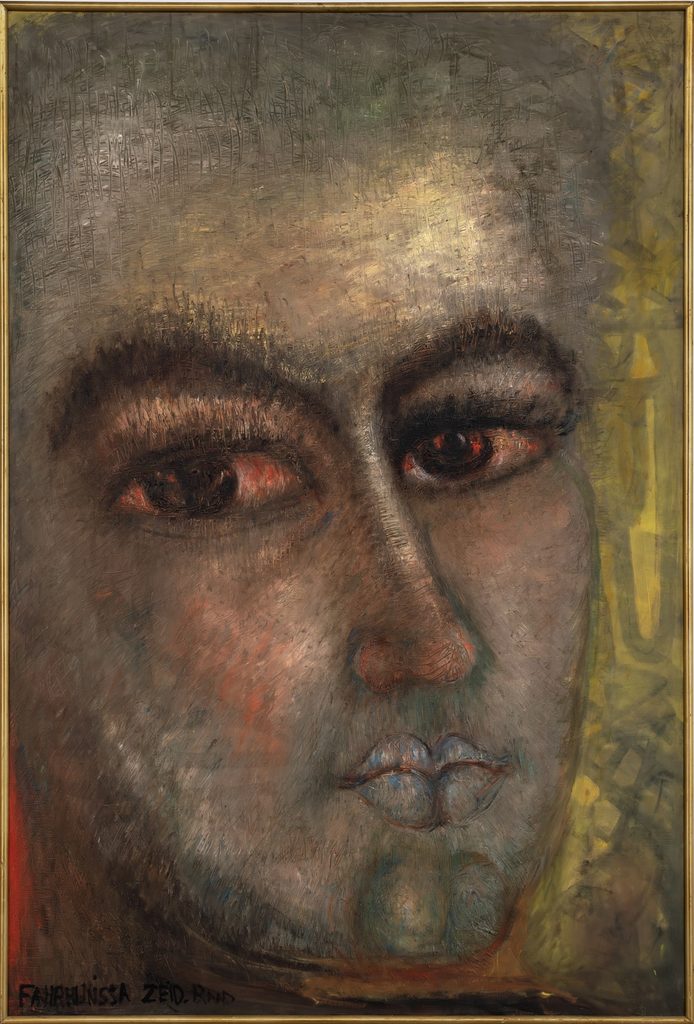
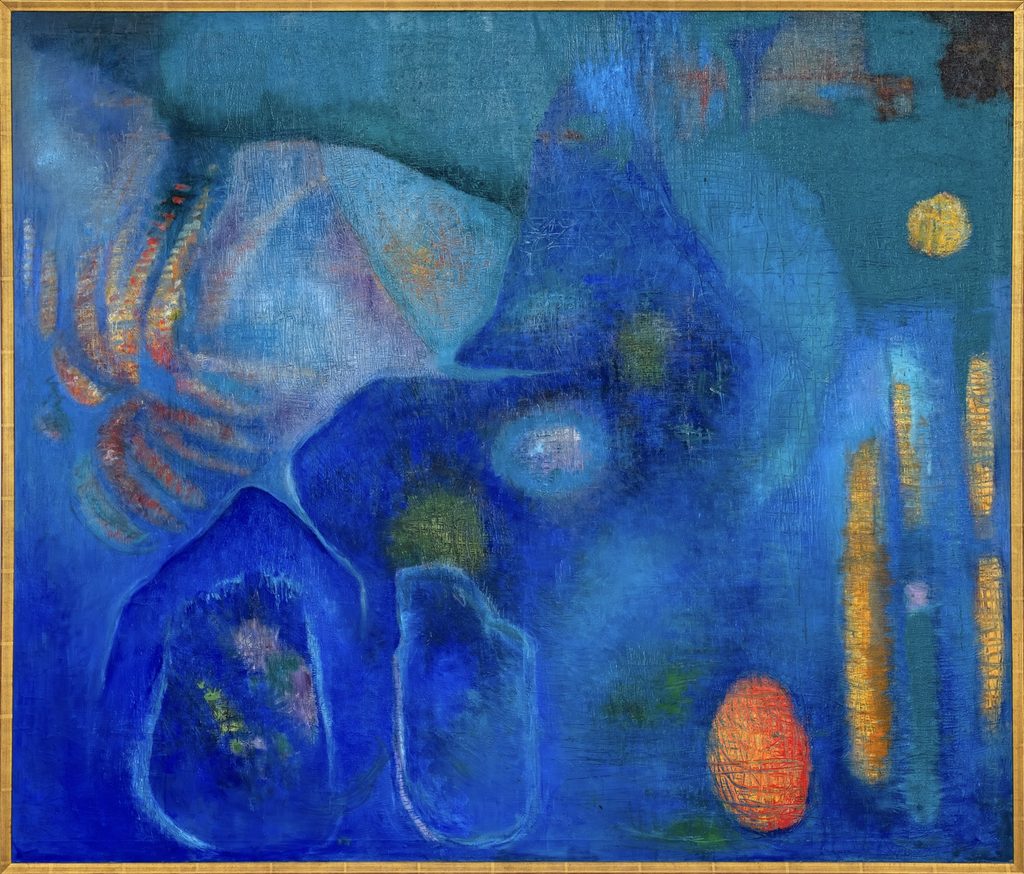
After a brief interruption and a series of sui generis works after the 1958 coup in Iraq, Fahrelnissa returned to painting in earnest in 1961, inaugurating a period of multimedia output with large paintings of varied themes. They encompass exuberant abstract skyscapes and underwater sensuous vistas from her Ischia island summers, such as Puncta Imperator (1963).32 Always interested by the cosmos, she also painted a few astral voyage-themed works in bi-chromatic renditions of glistening stars and mechanical grids of spaceships, as in the spectacular Flight of the Moon and Astronaut/Intruder (1965). In the same decade, Zeid inaugurated her return to figuration via large-scale close-up portraits of friends and family. She argued that portraiture was no different from abstraction, or a variation of it. It was “a sort of totality of art” that encompasses “structure, the colour, forms, the soul.”33 Her portraits share common features: large-scale, simple color scheme, meditative gazes, enlarged eyes, simplified features, hieratic presence, long brushstrokes, and an extensive use of the palette knife, which turned the planar surface of the sitters’ faces into abstract paintings-within-a-figurative-portrait, as is evident in The Adolescent (1964) and Emir Hassan (1968).34
At the same time, between 1968 and 1972, Fahrelnissa Zeid developed her Paléokrystalos. This dizzying output was shown in her last Paris exhibitions, as well as at her large 1964 homecoming retrospectives in Istanbul and Ankara. During her final Amman years, Fahrelnissa focused on teaching abstract art and painting private portraits.
CONCLUSION
What drove Fahrelnissa to work and paint prolifically from her twenties to her eighties, despite illnesses and tragedies? Art, for her, was a way out of her selfhood, like an “overabundance” that “starts where living does not suffice to express life.”35 She said that one does not paint to “make art” because “there is no art, no works of art. There is the joy of living, the joy of creating, because one is not enough to oneself.”36
The statements made and views expressed are solely the responsibility of the author, and do not represent Fiker Institute. To access the endnotes, download the PDF.