On Asmahan Elfergani: Within the Margins of History
INTRODUCTION
Asmahan Elfergani’s name circulates quietly, almost in whispers, spoken by artists, remembered by relatives, and briefly recalled in attempts to document Libyan artists and art history. Her work is not housed in national collections, nor recorded in art historical surveys. Instead, it is remembered intimately: a painting hanging in a home, a story recounted by a relative or family friend. These fragments, though scattered and fragile, speak to a legacy held in memory rather than in archives.
Elfergani’s absence from the formal record is not unusual for artists working in Libya. Unlike its regional neighbors, the country lacks public art museums, art history departments, or state-supported archives dedicated to cultural preservation. Years of authoritarian rule led to the systematic dismantling of independent cultural infrastructure, while decades of political instability have further eroded efforts to document the country’s artistic past. As a result, artists like Elfergani are often excluded from the dominant narratives of modern Arab art, which tend to privilege metropolitan centers such as Cairo, Baghdad, or Beirut.1 For example, in foundational anthologies like Modern Art from the Arab World: Primary Documents, Libya is altogether absent.2
This preliminary biography seeks to unveil the life of Asmahan Elfergani through what remains of her work and story: oral histories, recollections, and traces in private collections. It attempts to write from within the gaps—what some theorists might term a “heterochronic” approach—treating memory as both method and material.3 Drawing on frameworks from feminist archival theory and memory studies, this Essay proposes engaging with art historical narratives not as stories told only through institutions and archives, but also through homes, conversations, and the quiet persistence of remembrance.
BETWEEN LIBYA, LEBANON, AND EGYPT
Asmahan Elfergani’s early life was shaped by the political and educational realities of a newly forming Libya. She was born in Benghazi in 1946,4 at a time when the country—specifically Cyrenaica—was under British administration. By the time of independence in 1951, Libya faced severe educational underdevelopment and widespread poverty. Educational opportunities were minimal, with a literacy rate below 6%.5 However, change was underway: Libya’s first university was established in Benghazi in 1955, providing higher education opportunities within the country.6 Yet some Libyans, including Asmahan, continued to benefit from pursuing education abroad. In these conditions, access to arts education, especially for women, typically indicated privilege. This Essay uses oral histories from the artist’s niece, Ghaneya Elbarghathi, who shared stories she learned directly from Asmahan, and from Wareda Elmehdewi, Project Manager at Art House Gallery, who recounted memories passed down by her father, Khalifa Elmehdawi (a friend of Asmahan’s father), to gain a deeper understand ing of the artist’s early life.
According to this oral record, Elfergani spent her childhood in Lebanon, where her family lived for several years before relocating to Egypt around 1960. There, she completed her secondary education before enrolling in the Faculty of Fine Arts in Cairo.7 Despite their time in Lebanon and Egypt, the family maintained strong ties to Libya. Mobility between these countries offered the artist both stability and broader opportunities, while her cosmopolitan upbringing profoundly shaped her life experiences and artistic sensibility. Asmahan’s father, Ahmed Elfergani, was the first Libyan shareholder in Alitalia, the largest government-owned Italian airline at the time, while her mother, Ghaneya Elfergani, was a housewife.8 According to Elmehdawi, the family was affluent: “Due to her father’s wealth and line of work, she [Asmahan] enjoyed a luxurious lifestyle. His involvement with Alitalia made travel very easy for her, even with special care. As a result, she frequently traveled across Europe—sometimes alone, which was unusual for women at the time. She also developed a keen sense of fashion, due to his close ties with famous Italian designers.”9
Living in these diverse cultures may have influenced Asmahan’s artistic formation. Her mobility not only granted her access to education but also enabled her to navigate multiple cultural contexts. Yet ultimately, Asmahan’s art remained intimate and personal, reflecting her lived experiences rather than broader political narratives. Instead of turning outward to depict grand or political themes, she was drawn to the familiar and immediate; scenes and figures that surrounded her. Her artistic language remained grounded in personal experience and relational memory.
ELFERGANI’S WORK AT THE SCHOOL OF FINE ARTS IN CAIRO
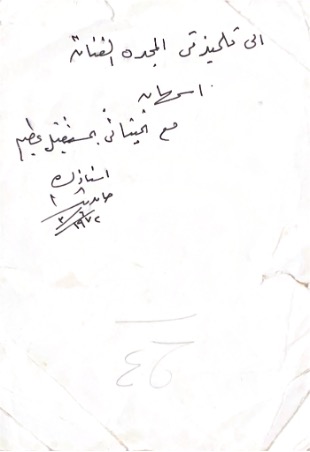
Several factors shaped Asmahan’s path toward studying art at the Faculty of Fine Arts in Cairo. In high school, the artist contracted a fever that led to partial hearing loss. Although her hearing diminished over time, it never resulted in complete deafness, contrary to what some sources suggest.10 In describing the artist’s daily life as a university student, her niece shared: “She would walk to the faculty everyday, that’s how close it was to her house”.11 Her condition and interests, combined with the proximity of the faculty to the family home in Cairo, made the pursuit of her higher education at the faculty ideal for her.
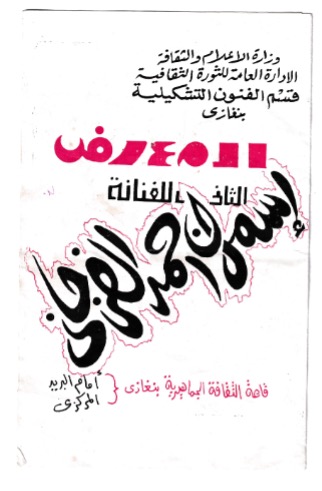
Elfergani’s formal training laid a strong foundation for her artistic journey, leading to early exhibitions in both Libya and Egypt. The artist participated in the 11th and 13th Spring Group Exhibitions in Cairo in 1972 and 1974, the 3rd Plastic Arts Exhibition in Benghazi in 1972, and the Plastic Arts Exhibitions held in Tripoli in 1974 and 1976.12 She also took part in the “April First” exhibition at the Islamic Call Society building in Benghazi in 1976.13 She graduated in 1975 from the Free Department at the Faculty of Fine Arts in Cairo, where she studied under prominent Egyptian artists such as Hamed Nada—an influential member of the Contemporary Art Group, an Egyptian art collective that advocated for a practice rooted in local culture, symbolism, and national identity14—as well as Hosni Elbanani and Abdel Aziz Darwish. After returning to Libya, she briefly worked in the makeup department of the Benghazi Broadcasting Channel while continuing to exhibit her work. Her first two solo exhibitions were held in Benghazi in the late 1970s and early 1980s.15 Notably, Elfergani was among the artists featured in the 3rd Arab Biennial in Tripoli in 1980.16
Although Elfergani produced a significant body of work throughout her life, much of it was tragically lost, leaving behind only scattered remnants. The majority of Elfergani’s paintings are thought to have been produced during her studies in Cairo, though some date from much later periods. According to her niece, the artist created many paintings, some gifted to friends and family, but most were either damaged or lost in a fire during the 2011 revolution in Benghazi.17 Wareda, whose father has two of the artist’s works in his personal collection, recalls that she knows of only eight surviving paintings. These include primarily portraits of family members, along with one landscape and a self-portrait.18
INTIMACY, AGENCY, AND LABOR
Elfergani’s training in 1960s Cairo placed her within the heart of Arab modernist experimentation, a period when artists debated “art for the people” and the role of the artist in post-revolutionary society. Figures such as Hamed Nada, Elfergani’s instructor, were central to these discussions. Yet her work diverged from dominant nationalist aesthetics by foregrounding female subjectivity and domestic ritual. In this sense, her intimate realism closely resembles contemporaries like Gazbia Sirry or Tahia Halim, whose practices emphasized memory, labor, and the poetics of everyday life.19
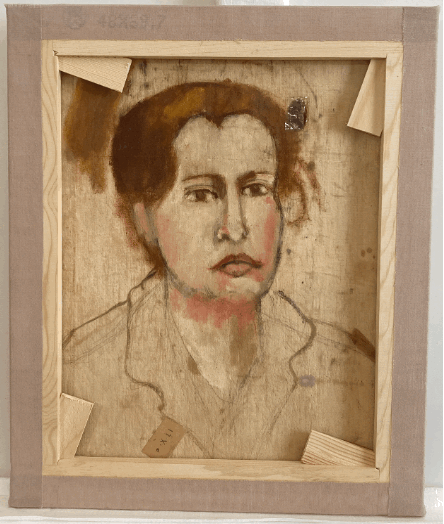
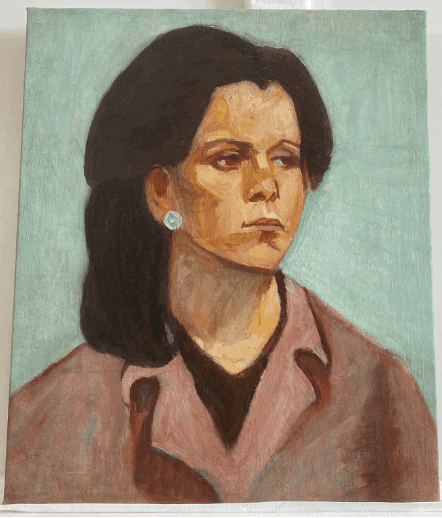
Elfergani’s Portrait of a Woman (1984), which resides in the Barjeel Art Foundation’s (BAF) collection, depicts a woman—presumably seated— rendered in warm, earthy tones: ochres, terracotta, and soft browns. The figure is situated against a teal background that echoes the color of her earring. The painting’s firm three-quarter tilt and brushwork recall Abdel Hadi El Gazzar’s Portrait of Salah Youssef Kamel (1960). The background offers no spatial clarity, just soft strokes and tonal gradients, focusing all attention on the figure her self. It is a quiet, inward-looking image, suffused with stillness. There is no evidence of who the sitter is, nor any markers of her status, yet her style is characteristic of the time. The reverse side of the painting features a looser, more gestural composition, possibly an unfinished or discarded preliminary sketch. In contrast to the frontal painting, the subject’s eyes meet the viewer directly, and her facial features appear slightly distorted. It is far more striking, as opposed to the more disengaged depiction of the primary portrait. One can’t help but wonder why Elfergani made these changes. Was it an attempt to portray the subject as more dignified, or less confrontational? Were they driven by aesthetic considerations, or shaped by cultural norms? Regardless, the woman’s averted gaze and composed posture suggest not passivity, but interiority and agency; she is not merely an object of the viewer’s gaze. She resists the subject-object binary and subtly challenges the dynamics of visual pleasure, as theorized by Laura Mulvey in her seminal book Visual and Other Pleasures.20 As Stefania Sorrentino notes, “A woman may not own the notion of the gaze, but she can control and maneuver it at her liking.”21 Through these aesthetic choices, Elfergani constructs a representation that is both emotionally complex and intentionally non-idealized.
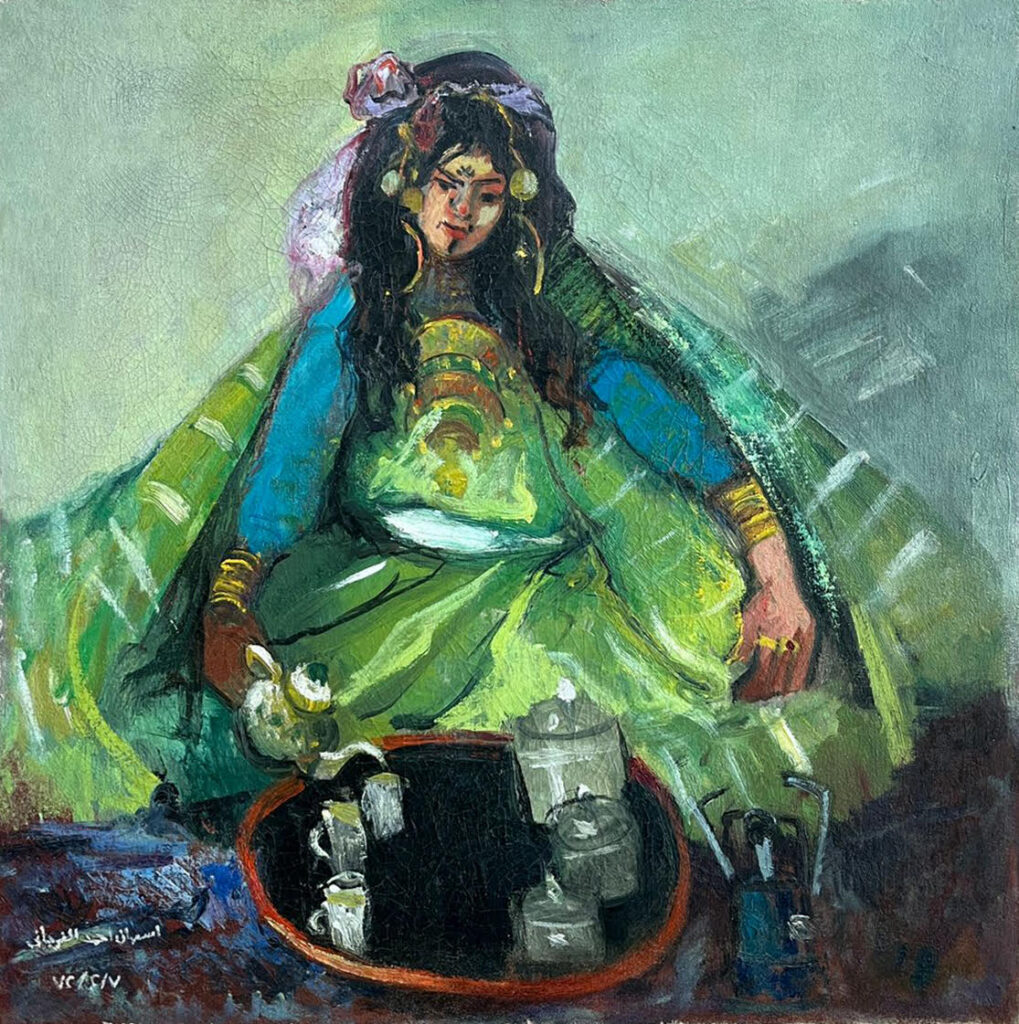
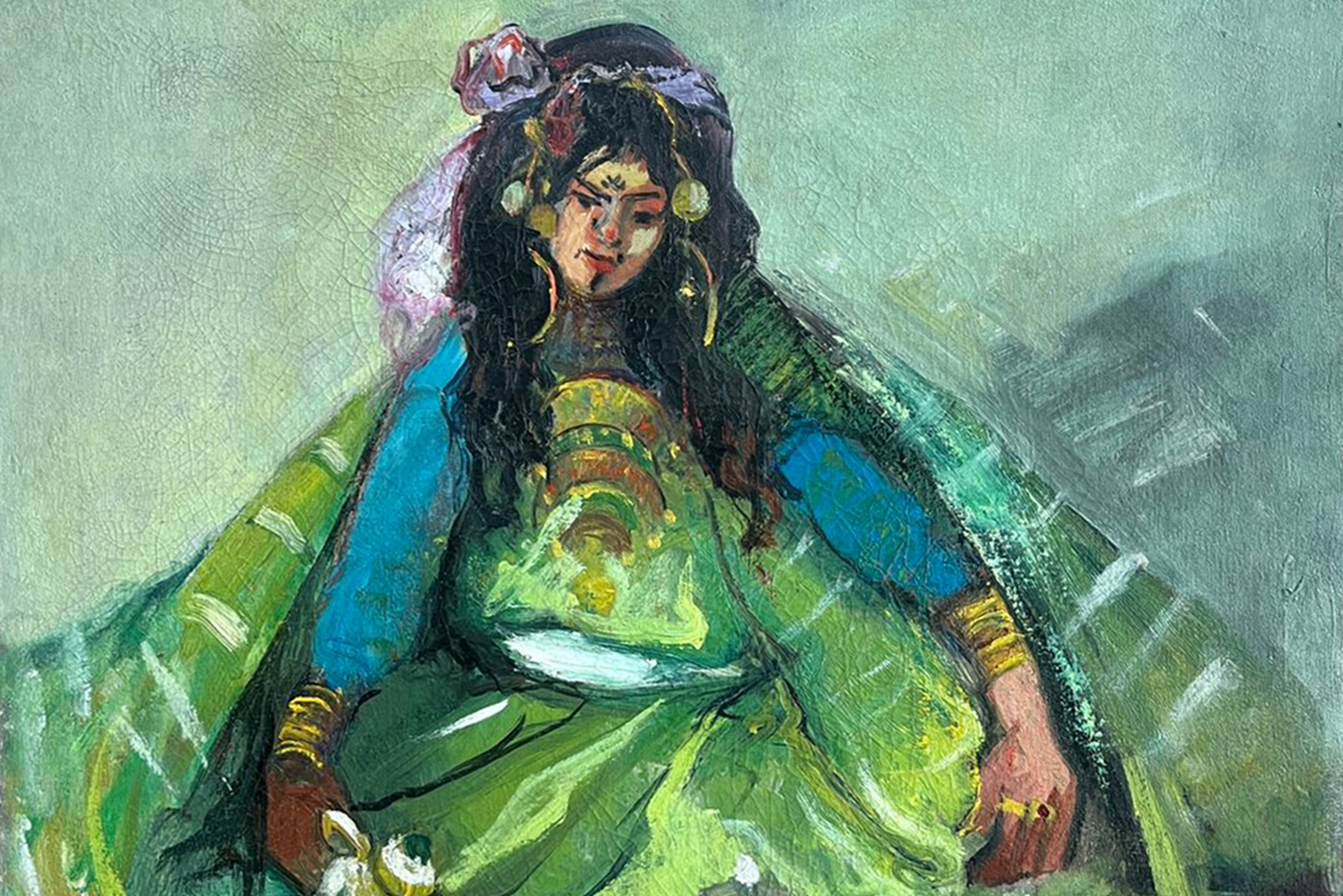
Another of Elfergani’s painting in the BAF’s collection captures a quiet, everyday ritual. The Libyan Women (1972) depicts a figure wearing a traditional garment, her face adorned with intricate facial tattoos, seated cross-legged as she pours tea using an e’dala—the traditional tea set used in tea-making ceremonies. Her body leans gently forward, gaze cast downward, and arms gracefully extended, forming a compelling triangular composition. The gesture is intimate and familiar, rendered with loose yet deliberate brushwork. The scene is richly colored: the glittering yellow of her gold jewelry, the bright green of her striped ḥrām, and bursts of blue and purple in the patterned carpet all enliven the space. These vivid elements are set against a background of muted teal and sage green tones, reminiscent of the ones used in the portrait mentioned above, maintaining visual consistency despite the 12-year gap between the two pieces. Elfergani neither exoticizes nor monumentalizes the scene; instead, she presents the act of tea-making as a quiet assertion of presence. The intimacy of the gesture, framed by a stable triangular composition, enacts what Pollock terms a “feminist intervention”22 in representation, by placing care and ritual at the aesthetic center.
ON MARGINS, REPRESENTATION, AND CULTURE
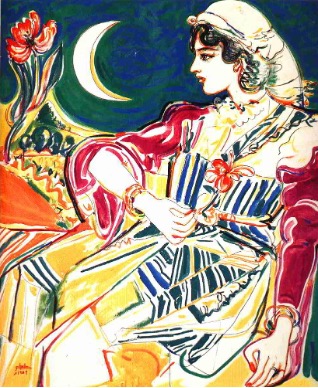
Due to the absence and/or inaccessibility of archival material on female Libyan artists from this period, it is difficult to identify contemporaneous women practitioners whose work could be meaningfully compared to Elfergani’s. Therefore, the following section puts her practice in dialogue with her male contemporaries, while acknowledging the gendered gaps that persist for various reasons beyond the scope of this Essay.
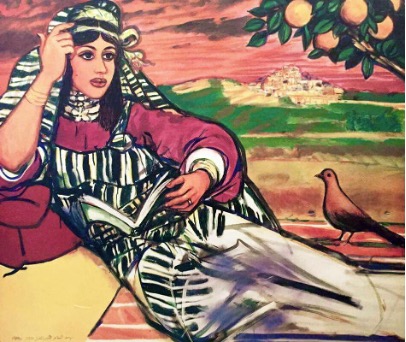
In Libya, cultural policies during Muammar Gaddafi’s early rule were marked by ambivalence—at times encouraging nationalist aesthetics, while at others stifling artistic expression under the weight of ideological conformity. Consequently, local artistic production became stylistically suspended between a melancholic impressionism and a modernism subtly inflected by socialist realist sensibilities.23 This aesthetic tension was further shaped by the arrival of Iraqi art educators, many of whom had studied in the Soviet Union and relocated to Libya after political exile during the Ba’athist rule.24 Several artists, like Asmahan, had been trained abroad, but not all were able to educate or disseminate their knowledge locally.25
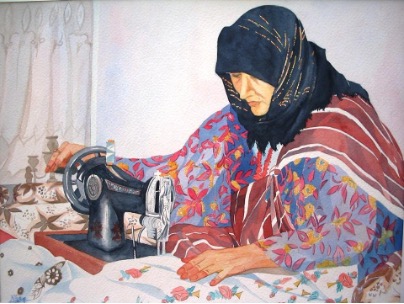
paper. Image source: Assaqeefa Alleebiya.
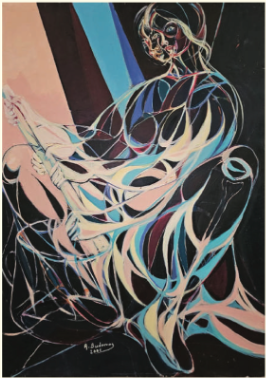
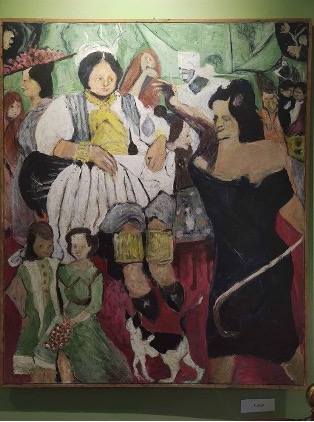
Against this backdrop of shifting aesthetics and constrained expression, artists navigated representations of culture and identity in different ways. Works that addressed culture typically consisted of nostalgic scenes of the old city, still lifes, or portraits. Representations of tradition are often anchored in public space, as seen in the works of Awad Obaida (1923 – 2014), where the city’s architecture, landscape, and communal life take center stage. Women, in these narratives, are frequently portrayed either symbolically or as vessels of heritage, their traditional garments bearing the weight of identity. Even when positioned as central subjects, their representation remains largely allegorical. For instance, the painting of a lady and a crescent moon in the background (1989) and the painting of a reclining woman (c. 1970s) by Al Taher Al Amin El Moghrabi (1941 – 2017) exemplify this tendency—foregrounding the female figure while encoding her within a broader national or folkloric framework. Nevertheless, intimate depictions of women performing domestic tasks continue to appear in the works of artists like Mohamad Esteita (1936–2005), Ahmed Bodera’a (1944-2014), and in portrayals of private traditional ceremonies, as seen in The Bride (date unknown) by Ramadan Bakshishi (1938–2024). Despite each artist’s vastly different techniques and styles, these representations often remain somewhat distant and external, focusing more on broader artistic themes such as space, movement, and the formal qualities of the composition rather than offering a deeper engagement with the female subject.
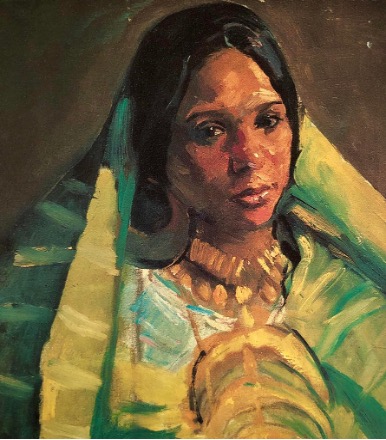
(1976). Oil on canvas, 60 x 45 cm.
Image courtesy of Ali Abani.
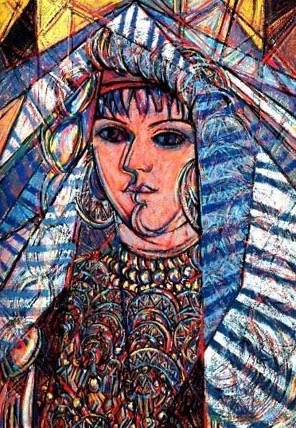
Elfergani’s subjects, by contrast, appear quietly self-defined. The Libyan Lady (1976) stands out as Asmahan’s most famous work. The painting explores identity with emotional nuance, depicting a dark-skinned woman with black hair, wearing a bright green ḥrām arranged atop her head into a triangular shape. Bold yellow strokes accentuate her intricate jewelry, contrasting with the finely rendered reflective earring. Her chin tilts gently downward, while her eyes glance upward, meeting the viewer’s gaze with a subtle, quietly assured glance. The brown back ground deepens the chromatic contrast, further accentuating her features. In composition, it bears resemblance to Bashir Hammouda’s (b. 1948) untitled vivid portrayal of a woman. However, where Hammouda employs geometric abstraction and plays with light and spatial construction, Asmahan privileges psychological presence over formal experimentation. The Libyan Lady diverges from more distant, iconic, symbolic, or folkloric treatments of women due to the emotional depth it bears.
The painting was exhibited in Elfergani’s early solo shows, in addition to the 3rd Arab Biennial in 1980. It later gained widespread recognition after being prominently featured on the cover of several publications, such as Four Seasons magazine in 2002,26 and later on the cover of the book Libyan Folktales: A Sociological Study (Al-Ḥikāyah al-Sha‘bīyah al-Lībiyyah: Dirāsah Sīsiūlūjiyyah) by Dr. Fatima Ghandour, published in 2010.27 The artist was also featured on the cover of Al-Bayt magazine in 1978.28 Some critics have argued that Elfergani’s work was overly influenced by Egyptian styles and lacked distinctively Libyan elements,29 a critique her later works may have sought to address. It is worth noting that Elfergani’s paintings suggest a personal investment in representation, not merely of women, but of individual interiority and presence.
CONCLUSION
source: Assaqeefa Alleebiya.
Even among those who once encountered her work first hand, Asmahan Elfergani’s name now lingers only faintly. Despite having personal access to Elfergani’s work and even owning a few pieces, the owner of Iskandar Gallery, Mustafa Iskandar, reveals just how scarce information about the artist and her work is, even locally. While he recalls some of her works, he admits that “news of her faded in the ’90s, and no one, at least within my circle, has heard of her since.”30
He is not alone in this. When asked about meeting Elfergani, Libyan critic and visual artist Adnan Metig responded, “Sadly, I do not hold much information about the artist and have only seen one or two of her paintings.”31 These reflections underscore how Elfergani’s absence from documentation extends beyond gaps in regional art history; it highlights how even those within the local art community have lost touch with her work.
In contrast, some of her counterparts, such as Ali Abbani, Tijani Ahmed, Bashir Hammouda, or Ramadan Bakshishi, while still under-recognized, have been relatively more recorded and celebrated locally. Elfergani remains an elusive figure even within local art circles, her story slipping further into the background with each passing decade. Her works, though remembered by a select few, reflect a presence that has quietly faded from view. She stopped painting relatively early in her life, but the reasons for her withdrawal, and for the obscurity that followed, remain unknown.
Seeking to trace and understand Elfergani’s life and work shows how such luminous creative journeys can easily fade away. Though her recognition has dimmed, there remains an undeniable trace of her presence, not through institutions or exhibitions, but in the quiet memories of those who know or knew of her. Her niece’s testimony is a reminder that an artist’s significance is not solely measured by public recognition, but by these small, enduring acts of remembrance. While her name may not yet echo as loudly as some of her contemporaries, it persists in these deeply personal moments, and perhaps, in the end, that may be its most enduring form.
The statements made and views expressed are solely the responsibility of the author, and do not represent Fiker Institute. To access the endnotes, download the PDF.