Gulf Foreign Policy Amid Escalation & Alliances
The US and Israel’s strikes against Iran since February 28 mark a pivotal moment in the Gulf’s security architecture. They transformed what had previously been a gradual recalibration of alliances into an immediate strategic dilemma for the GCC states. Iran’s direct attacks targeting Gulf territory and infrastructure exposed the double-edged nature of hosting US military assets, which remain central to deterrence but increase their exposure to retaliation and escalation. This has intensified long-standing concerns about overdependence on external security guarantees and accelerated ongoing efforts by GCC states to diversify their strategic partnerships.
However, rather than abandoning US security ties, GCC states are pursuing calibrated hedging strategies that combine continued defense cooperation with the US, expanding European security engagement, and strengthening economic and technological ties with emerging powers like China. The result is a more multidirectional foreign policy behavior, shaped by both systemic pressures and domestic priorities, as they seek to balance deterrence, autonomy, and threats in an increasingly volatile regional environment.
Despite a shared rationale, the scope and implementation of hedging differ across the GCC states. This Policy Brief identifies the key drivers that have shaped variation in Gulf hedging strategies, ranging from threat perceptions and domestic constraints to leadership priorities, and assesses how the varying approaches have affected the bloc’s alignment with both traditional and emerging partners.
HEDGING FOR MODUS VIVENDI: BETWEEN AUTONOMY AND INTEROPERABILITY
For decades, the US has functioned as the principal security guarantor for GCC states, shaping both their external alignments and the structural limits of their strategic autonomy.1 While close alignment with Washington has delivered critical security and military protection for the Gulf bloc, US-GCC ties have also imposed constraints on Gulf foreign policy maneuverability. Qatar’s mediation diplomacy in Palestine and Afghanistan, for example, has largely reinforced US strategic preferences or, at a minimum, avoided overt divergence with US foreign policy. Similarly, Oman and Kuwait have functioned as sanctioned intermediaries in US-Iran engagement, while Saudi coordination with US priorities during the War on Terror leveraged religious authority and financial capacity in ways consistent with US security strategies. As Hamdi and Salman further explain, US-Gulf alignment produces asymmetric dependency, exposing GCC states to a dual vulnerability: abandonment risk as US regional priorities shift, and entrapment or provocation risk should their ally’s actions trigger responses from rival powers, as demonstrated by the ongoing US-Israel-Iran war.2
Against this backdrop, growing elite dissatisfaction with the constraints of patronage has catalyzed a turn toward “omnibalancing”3 — a strategy that engages both allies and adversaries to address and mitigate a challenging geoeconomic environment. Instead of simply bandwagoning with Washington or aligning with Russia and China, the omnibalancing behavior of the UAE, Saudi Arabia, and Qatar during the Arab Spring era reflected their respective governments’ calculus toward both domestic and regional threats,4 considering the challenge of Iran’s influence alongside the rise of Islamist political forces. In practice, these three GCC states took assertive, if differing, actions, namely interventions in Bahrain, Yemen, and Libya, or offered support for rival factions abroad to counter perceived internal or regional antagonists. However, these states still relied on great power patronage to secure their stance and position.5
Hedging thus emerges not as strategic indecision, but as a structured response to the autonomy–interoperability dilemma. By diversifying external partnerships, GCC states seek to expand strategic maneuverability while preserving access to US security infrastructure. In fact, the decline of unipolarity and emergence of new poles, such as China, gave middle powers an opportunity to diversify partnerships.6 Hedging allows GCC states to benefit from great power competitions without committing ideologically.7
DIVERGENT HEDGING STRATEGIES
The UAE, Saudi Arabia, and Qatar have adopted different hedging strategies amid US–China competition.8 Their scope differs based on their respective foreign policy circumstances,9 varying across economic, political, and security contexts,10 and differences in territorial size, resources, threat perceptions, and confidence in the US security umbrella.11 The respective hedging strategies of the UAE, Saudi Arabia, and Qatar should be understood not as a singular posture, but as a differentiated set of practices calibrated to distinct national constraints and opportunity structures.
Qatar’s hedging strategy is shaped by the country’s geographic constraints and historical vulnerabilities and is characterized by restraint and alliance reassurance, privileging economic diversification and mediation diplomacy while maintaining explicit reliance on US security guarantees. Saudi Arabia, by contrast, has adopted a more assertive and expansive form of hedging, leveraging its economic weight and geopolitical influence to broaden defense, energy, and diplomatic ties, especially with China and other emerging partners including Pakistan. Riyadh deploys this strategy as leverage to enhance its autonomy and renegotiate the terms of its longstanding partnership with Washington. The UAE occupies an intermediate position, pursuing a diversified and agile hedging strategy that integrates economic statecraft, soft power, and selective military capacity, while retaining the flexibility to recalibrate when costs or risks escalate.
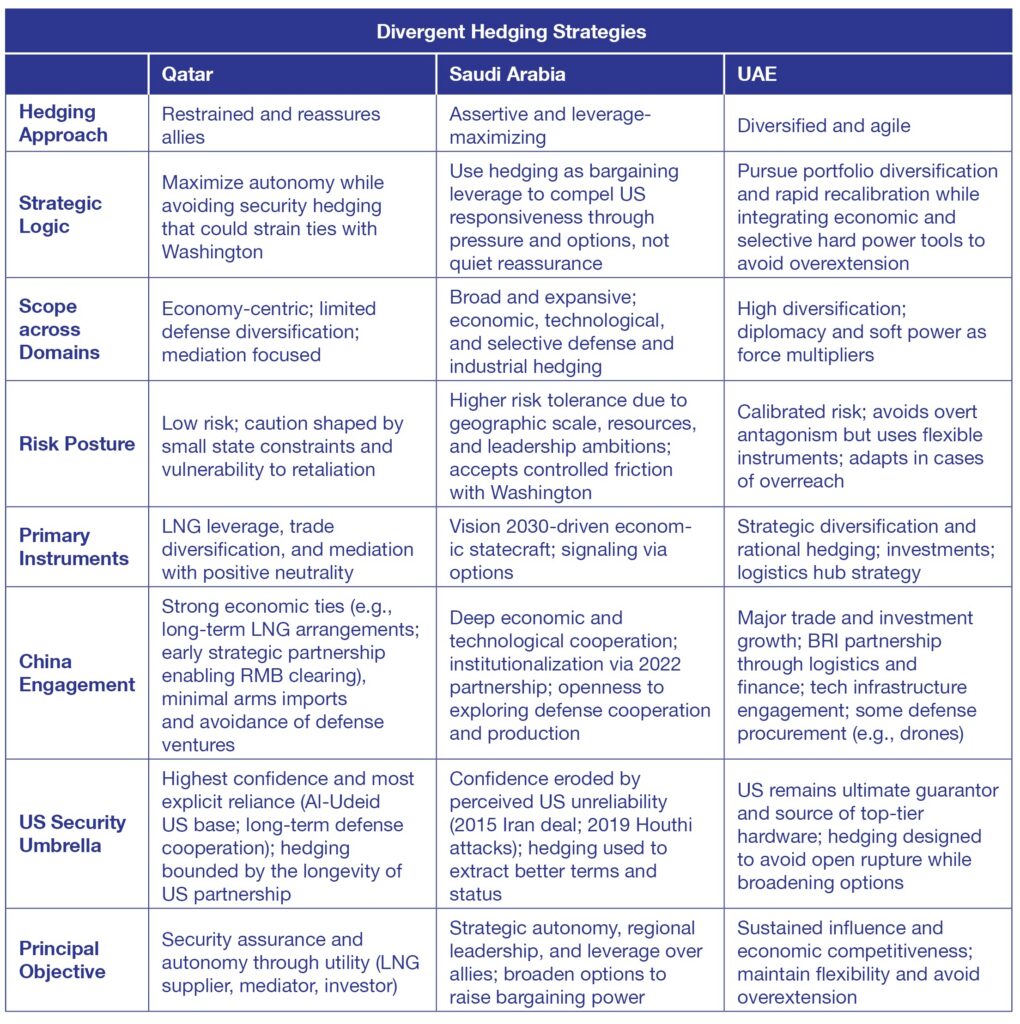
Taken together, Saudi Arabia, the UAE, and Qatar demonstrate that hedging among the GCC states is best conceptualized as a continuum rather than a binary choice between alignment and realignment. The principal variation lies not in whether these states hedge, but in how they manage the autonomy–interoperability trade-off under conditions of growing multipolar uncertainty. Notwithstanding, their different hedging approaches do not exist in a foreign policy vacuum of the other three GCC states, Oman, Kuwait, and Bahrain.
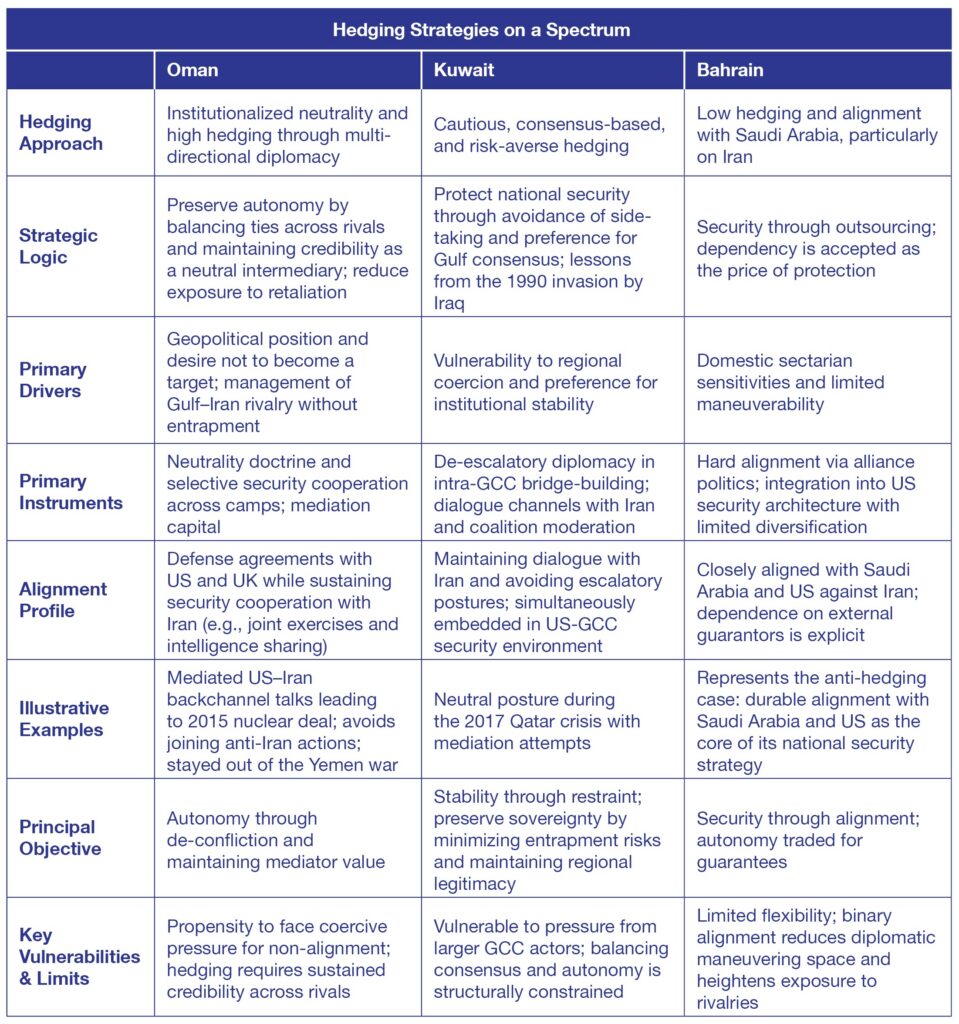
Hedging in Oman, Kuwait, and Bahrain operates along a clear spectrum shaped by vulnerability, threat perception, and strategic latitude. Oman represents institutionalized hedging, framed by neutrality and multi-directional diplomacy to preserve its autonomy while minimizing exposure to retaliation. Kuwait occupies a cautious middle ground, where historical experience and state vulnerability incentivize restraint, mediation, and consensus-seeking behavior. Bahrain, by contrast, illustrates the boundary condition of hedging: structural vulnerability compels firm alignment with Saudi Arabia and the US. Unlike Qatar, the UAE, and Saudi Arabia, the approaches of Oman, Kuwait, and Bahrain show that hedging is not universally available to small states but contingent on relative strategic depth.
INSTITUTIONALIZING GCC HEDGING UNDER MULTIPOLAR STRAIN
For decades, the US has functioned as the principal security guarantor for GCC states. As the preceding analysis indicated, GCC hedging is likely to persist; however, the approach will become harder to sustain as the US–China rivalry sharpens and the long-term impact of the Iran War becomes apparent. Washington increasingly treats selected technology, AI, and security linkages with China as incompatible with US-anchored interoperability.14 Qatar’s, Saudi’s, and the UAE’s strategic challenge is therefore not whether to hedge, but how to discipline hedging to consolidate autonomy gains without triggering abandonment risks, punitive technology restrictions, or a forced binary alignment choice.15
Policy Recommendations
1. Adopt sectoral guardrails to keep hedging below escalatory thresholds
GCC states should individually codify internal red lines that differentiate low-risk economic engagement from high-risk security and technology entanglements. This requires treating hedging as a portfolio strategy with explicit thresholds, particularly in sensitive domains including AI infrastructure, telecommunications, dual-use systems, and nuclear cooperation, where US concerns are most acute.16 Such guardrails preserve policy coherence and reduce inadvertent signaling that diversification equals strategic defection.17
2. Prioritize interoperability as the non-negotiable security core
US security guarantees remain functionally irreplaceable in the near term, even as economic gravity shifts toward China.18 GCC states should therefore treat military interoperability with the US, especially in training, command integration, and intelligence coordination as the hard anchor of their hedging portfolio. This course of action does not preclude diversified procurement, but it requires that diversification does not degrade readiness, intelligence integrity, or alliance-enabled deterrence.19
3. Hedge for bargaining power, not for escalatory signaling
Hedging can expand autonomy when the strategy functions as risk insurance and option creation, but it becomes counterproductive when used as coercive signaling. Saudi Arabia’s more assertive diversification may yield leverage, yet the policy pay off diminishes if its approach accelerates a ‘with us or against us’ posture from the US.20 GCC states should strategize hedging as a stabilizing mechanism: keeping the US sufficiently invested in Gulf security while ensuring China remains economically engaged without turning the Gulf bloc into a theater of overt alignment competition.21
4. Exploit structural economic shifts while containing strategic exposure
The macro-trend is unmistakable: by 2020 China surpassed the US and EU as the GCC states’ top trading partner. In 2021, China–GCC trade was reportedly $225 billion compared to roughly $75 billion in US–GCC trade.22 By 2023, China had consolidated its position as the GCC’s leading trading partner with a total GCC–China merchandise trade reaching $297.9 billion,23 a volume that substantially exceeded reported US–GCC trade of about $80.1 billion in 2023.24 China’s deepening reliance on Gulf hydrocarbons, namely Saudi and Emirati oil, and Qatari liquid natural gas (LNG), creates sustained interdependence and bargaining leverage.25 GCC states should capitalize on this leverage to secure investment, technology, and market access, while avoiding security-sector commitments that invite retaliatory restrictions from Washington or strategic retaliation from competitors.26
5. Reduce vulnerability to abandonment and entrapment
GCC states should mitigate the risks of dependency by pairing interoperability with measured diversification, and by investing in capabilities that reduce reliance on foreign personnel and external expertise without imagining near-term self-reliance as feasible.27 Hedging is a strategy for managed autonomy, not a substitute for credible security architecture.
6. Institutionalize collective infrastructure mechanisms
To keep hedging viable following the February 28 retaliatory spillover, GCC states should adopt and institutionalize a collective mechanism designed to address critical civilian infrastructure challenges, and to mitigate escalatory risks associated with hosting external military assets. Whether formalized within existing Gulf security frameworks or developed through commercial arrangements, the mechanism would enhance early-warning sharing,28 harmonize strategic messaging, and coordinate defensive posture adjustments during crises.29 By aligning responses to retaliatory risks, GCC states can reduce asymmetric exposure and strengthen bargaining leverage with external partners by signaling Gulf cohesion without constraining national autonomy.
CONCLUSION: HEDGING AS DISCIPLINED STATECRAFT
In an escalating regional environment, hedging occupies the strategic space between alliance and defection, enabling GCC states to expand maneuverability under conditions of uncertainty.30 Yet as the US-Iran confrontation widens, and as great power rivalry between the US, China, and Russia increasingly penetrates technology and defense ecosystems,31 undisciplined hedging will invite backlash and shrink policy space. The policy imperative is therefore to institutionalize hedging through guardrails, reassurance, and interoperability by converting diversification from episodic tactics into a coherent strategy that preserves autonomy without sacrificing deterrence or provoking coercive escalation.
The current US-Israeli war on Iran is increasingly shaping a new regional dynamic where divergent positions among GCC states are becoming more visible. The UAE, Saudi Arabia, Kuwait, and Bahrain appear to align more closely with US strategic objectives, while Oman and Qatar continue to emphasize de-escalation and mediation. This differentiation reflects varying threat perceptions and risk tolerances, complicating the formation of a unified regional stance. The absence of consensus reduces the likelihood of collective diplomatic leverage and instead reinforces a fragmented security environment in which individual GCC states pursue parallel strategies.
The statements made and views expressed are solely the responsibility of the author, and do not represent Fiker Institute. Download the PDF to access the endnotes.