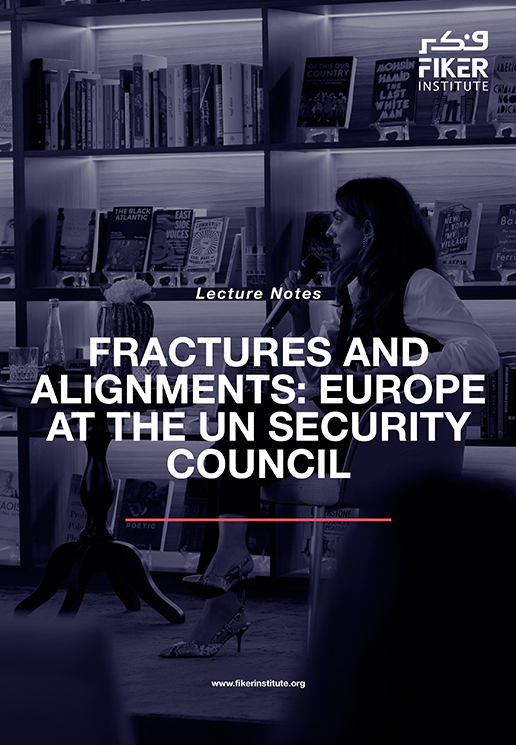
Fractures and Alignments: Europe at the UN Security Council
Fiker Institute hosted Senior Fellow Shurouq Jaradat for a lecture on fragmentation in the United Nations Security Council (UNSC). The lecture explored how the war in Ukraine has intensified tensions among the United Nations Security Council Permanent Five (P5) and how shifts in US policy under President Trump, particularly regarding Russia and Ukraine, have reshaped dynamics among the P5 and ultimately affected coordination with European allies. Below are the key takeaways from the lecture.
HOW HAS THE UNSC GONE FROM MANAGED DISAGREEMENT TO OPEN FRAGMENTATION?
Disagreements among the P5 are not new. Before the war in Ukraine, however, the Council still managed to function: roughly 84% of resolutions were adopted by consensus, and vetoes averaged just two to three a year. The Council could predict where tensions would surface and contain them to selective agenda items. With Russia’s full-scale invasion of Ukraine in 2022, this balance broke down. A permanent member became a direct party to the conflict, and fragmentation within the Council reached a level that was “truly exceptional,” most clearly reflected in the spike in vetoes.
Veto use jumped from one in 2021 to four in 2022, all related to Ukraine, then to six in 2023 and seven in 2024. More troubling than the numbers is how the veto spread across previously less politicized files. What began as a Ukraine-specific crisis started to reshape how the P5 managed every disagreement at the Council.
This fracturing also showed up in working methods. The share of resolutions adopted by consensus fell to 65% in 2024 and 61% in 2025, signaling that members were less willing to compromise even on technical or humanitarian texts. At the same time, procedural votes – historically rare tools used to set agendas or schedule meetings – climbed to a record eight in 2024. This illustrates how the Council’s internal rulebook itself has become a new battleground, diverting efforts away from crisis management toward procedural fights over how the Council should function.
Western efforts to highlight the gravity of the Ukraine war contributed to what diplomats at the UN call the “Ukrainization” of the Council’s agenda. Western members increasingly referenced Ukraine across debates that were not formally about Ukraine, from sanctions files to thematic discussions. While politically understandable, this made it harder for other members to accept language in otherwise unrelated texts, hardening positions and widening gaps on issues that had once been easier to manage.
WHAT WAS THE IMPACT OF TRUMP’S RETURN TO OFFICE?
Trump’s return to the White House in 2025 was a second major shock to the system. The first UNSC resolution on Ukraine, adopted in February 2025, was a pivotal moment. The US tabled a very short text calling simply for an end to the conflict and a lasting peace, without assigning responsibility or affirming Ukraine’s sovereignty and territorial integrity.
European members pushed to postpone the vote and negotiate stronger language; Washington blocked the delay. They then proposed amendments, as did Russia. The US abstained on both sets of amendments, a striking departure from traditional P3 (US, United Kingdom, and France) unity. The resolution nevertheless passed, in language that Europeans saw as a major compromise. This episode set the tone of the new US policy: a willingness to “make a deal at any cost,” even where it diverged sharply from long-standing European positions.
HOW HAVE THE US AND THE EUROPEAN POWERS DIVERGED?
P3 cohesion, once a defining feature of Council politics, has become fluid. On Ukraine and Gaza, Europe and the US increasingly diverged: France backed ceasefire language while the UK initially aligned with Washington; later, the UK and France recognized the State of Palestine as the US blocked a resolution on Palestinian UN membership. Yet on other files, such as renewing sanctions on Iran, P3 coordination remained strong.
The February 2025 Ukraine resolution nonetheless exposed the limits of European leverage. If the text marked such a clear departure from Europe’s principled stance on sovereignty and accountability, European permanent members could in theory have vetoed it. Their decision not to do so revealed how dependent they remain on the US and how constrained they are when Washington’s preferences diverge from theirs. In a way, Europe enabled the US to cross a critical red line, further weakening its ability to set boundaries with Washington.
HOW ARE NEW ALIGNMENTS RESHAPING COUNCIL POLITICS?
Voting patterns in the February 2025 session opened space for new alignments. The US and Russia both supported the resolution, while China emphasized sovereignty and Europe’s role in any settlement and backed EU-proposed amendments linked to the UN Charter. Subsequent diplomacy – including President Macron’s visit to Beijing and a joint statement affirming that any solution to the war must be anchored in international law and the Charter – raised questions about whether some European capitals may increasingly see China as a partner on Charter principles more than the US, at least in the Council context.
Trump’s “peace plan” in Ukraine, advanced largely through bilateral channels with Moscow and Kyiv rather than multilaterally with Europe, reinforced this trend. Europe initially rejected the plan as too soft on Russia, but continuing negotiations and mixed US messaging signaled sustained pressure on Ukraine to make “difficult compromises,” including potentially on territorial integrity – another red line for Europeans that had already been diluted by the February resolution.
WHAT IS THE FUTURE OF US-EUROPE DYNAMICS IN THE COUNCIL?
Looking ahead, US–EU relations are more uncertain than ever, with risks of both confrontation and grudging pragmatic cooperation. The 2025 US National Security Strategy mentions Europe frequently but combines harsh criticism of the EU with support for nationalist, sovereignty-first movements, and language welcomed by Russia on limiting future NATO enlargement.
Taken together, these trends point toward a more fragmented Europe that is easier for Washington to approach bilaterally and harder to mobilize as a unified bloc, whether within the Council or beyond it. Combined with Russia’s security concerns, China’s growing diplomatic weight, and deepening polarization within European states themselves, the world is entering a period of structural reordering rather than a temporary deviation.
There is no going back to a pre-Ukraine, pre-Trump multilateral order. The Security Council remains highly active and visible but acts increasingly as a stage for public messaging rather than a forum for effective conflict resolution. The next decade is likely to bring a new international order whose contours are still unclear, but in which Europe will have to decide whether it can defend its core principles or remain aligned with the US while navigating a more fluid, transactional and fragmented Council.
The statements made and views expressed are solely the responsibility of the speaker and do not represent Fiker Institute.