Majid Magazine: Identity & Collective Memory
INTRODUCTION: A LEGACY OF LEARNING & EXPLORATION
In 1979, the first issue of Majid Magazine, one of the oldest publications for children in the Arab world, was published in Abu Dhabi in hopes that it would help shape knowledgeable and inquisitive generations of Arab and Emirati youth. Majid Magazine began production only eight years after the unification of the United Arab Emirates (UAE), when the country was still in its formative years and nation-building was in its earliest phases. The Magazine rapidly grew into a multi-faceted platform and a source of both entertainment and education, later expanding to serve as a powerful tool for the country’s cultural diplomacy. Its impact remains understudied in both archival research and case studies of soft power in the Gulf.
Following its establishment, Majid Magazine rapidly spread across the Arab world and contributed to forming a shared pan-Arab identity through its characters and themes. It promoted cultural exchange among a vast majority of Arab countries, and a deep appreciation for the Arabic language. The editorial direction of the Magazine in the first three decades of its establishment promoted a blend of education and entertainment that was able to capture the hearts of its growing readership. The iconic character of Majid wears a Khaleeji kandora and a ghutra on his head, portraying a young Emirati boy who goes on adventures, explores the world and shares all of its wonders with his friends. His name means ‘glorious’ and the character was inspired by the famous Ahmed Ibn Majid, a pioneering Arab navigator and traveler from the emirate of Ras Al Khaimah. The Magazine’s educational aspect was encapsulated by an influential character named Zakiya Al Thakiya or ‘The Clever Zakiya’, who introduces topics about science and the world around her and who is always able to solve complicated life problems. According to Ahmed Omar, Majid Magazine’s first editor-in-chief, who was interviewed for this Essay, the founding objectives of the Magazine were “to contribute to raising new generations […] loyal to their country […] armed with science and knowledge. The national identity of every reader of the Magazine was our concern. We were very keen on nurturing and rooting it in the hearts of the young.”1
This Essay explores how Majid Magazine was able to create a sense of shared identity among Arab children and youth in the early decades of its production, and how it became an effective tool of cultural diplomacy for the UAE in its formative years. The analysis also positions Majid Magazine in the wider framework of how media influences nation-building and cultural diplomacy, shedding light on the intricate relationship between media, culture, and national identity with a unique focus on children.
FOSTERING VALUES & PRIDE IN NATION
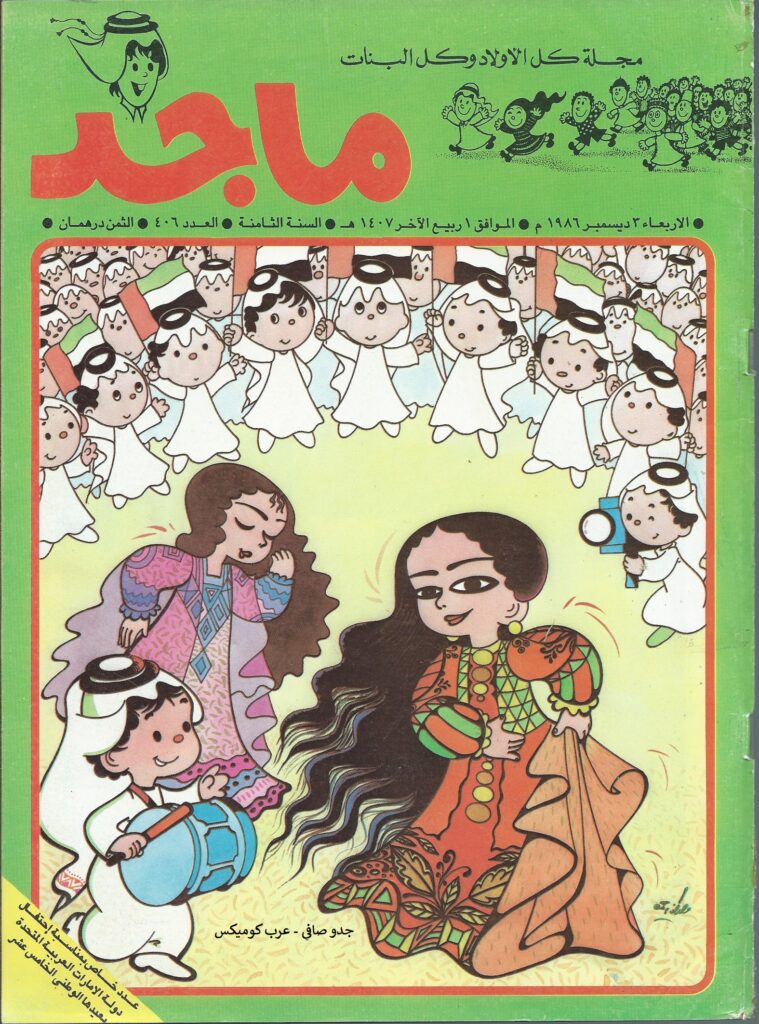
Majid Magazine continues to play a significant role in the collective memory of Emiratis across generations. The inclusion of rhetoric and narratives that celebrate the UAE’s cultural fabric and its national milestones have also contributed to instilling national pride and the feeling of belonging in Emirati children. This is evident in the early issues that Majid Magazine released in celebration of the UAE’s National Day and Sheikh Zayed’s Accession Day. Each issue was released with its own special cover. Jehan Safar, a Majid Magazine collector and avid reader, said: “An immense feeling of pride and joy used to overwhelm me when I realized that the special copies of the Magazine were going to reach a myriad of Arab countries, and the celebrative spirit of what the UAE has become will transcend the Arab world all thanks to a children’s magazine.”2
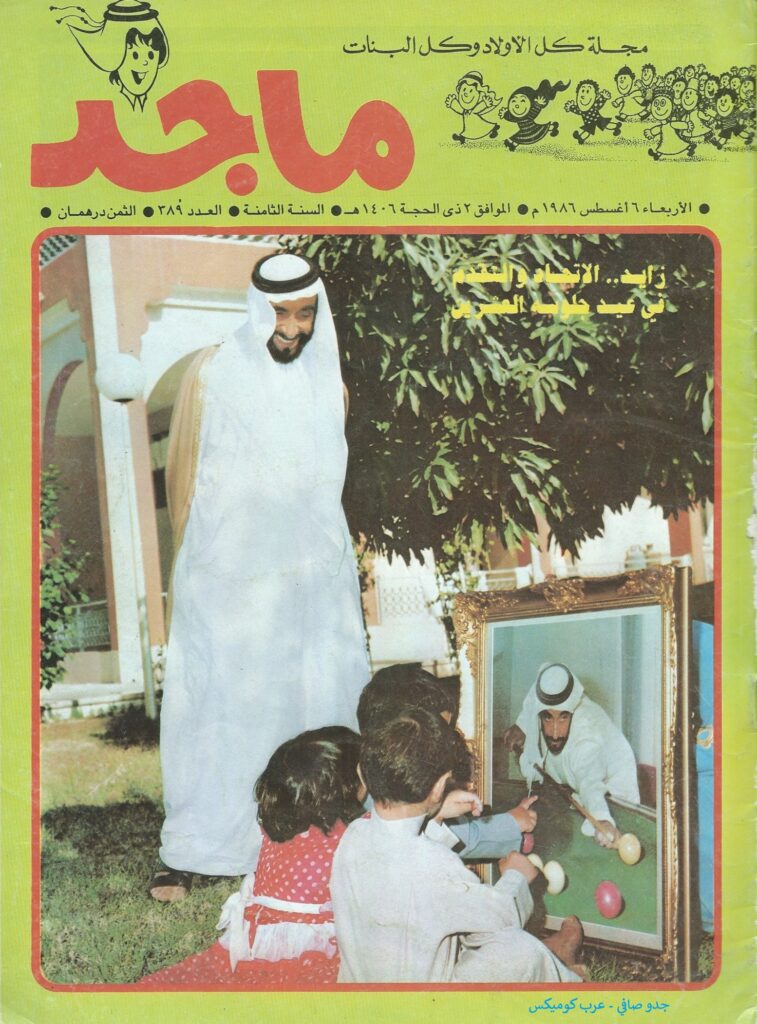
Additionally, the Magazine used to celebrate various national milestones, ranging from achievements in sports to the building of more roads and easing of transport in the early decades of the Union. In 1989, the UAE’s national football team reached the final qualifiers for the 1990 FIFA World Cup and qualified for the tournament for the first time. The Magazine celebrated with a headline that read: “President of the State honors the UAE national team on their qualification for the World Cup final. You have raised the flag of the UAE high. Your honorable achievement is a source of pride for the nation, and a source of pride for every Arab.”5 This sheds light on the concept of ‘shared experience’ brought forward by Benedict Anderson in his history of nationalism. Shared experience amongst a population, to Anderson, can create a binding agent to the nation. When a victory or defeat is experienced, it is experienced collectively.6 In many ways, Majid Magazine was a platform for the creation of such a shared experience.
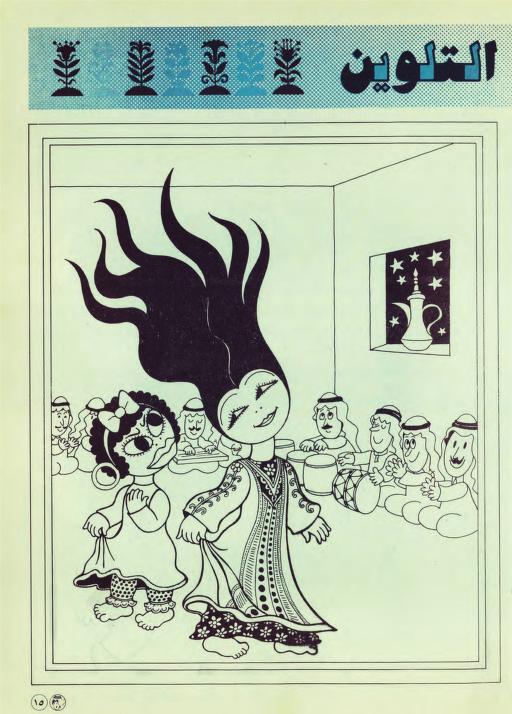
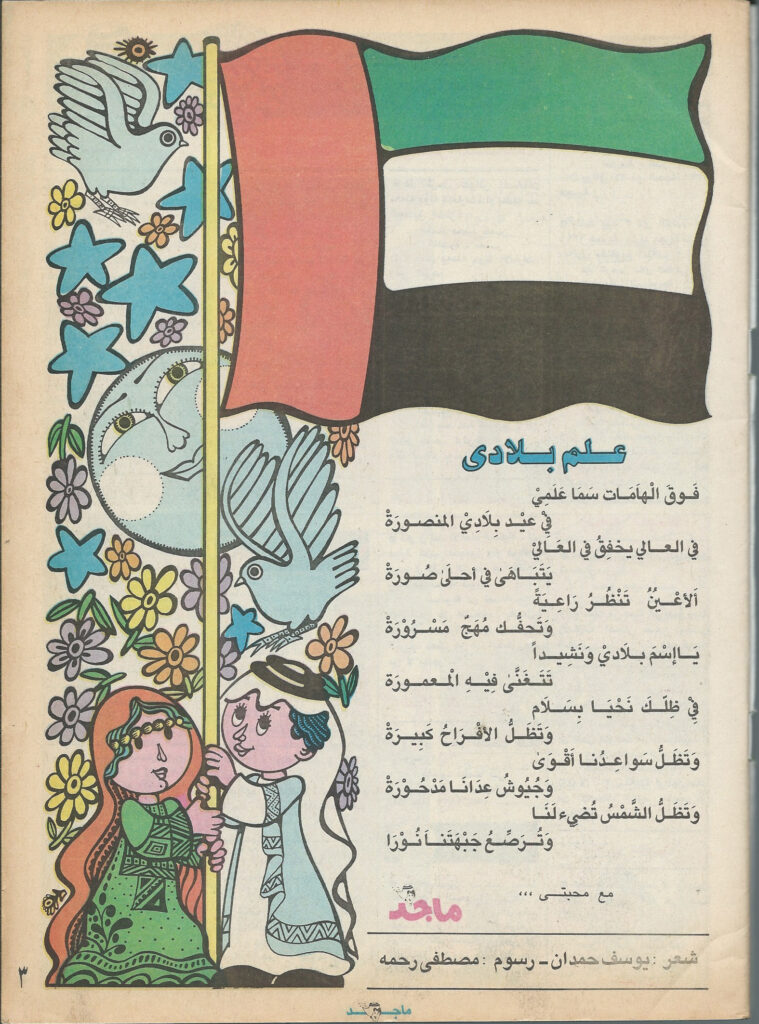
The Magazine also included activities that children could engage with to further exemplify values of national identity. An example of this was a segment where children were asked to color in the blanks and send their drawings back to the Majid offices to get the chance to be featured in the next issue of the Magazine. In one such issue, the Magazine featured a drawing that included ladies and men in celebration, most likely in a wedding setting. The lady featured in this specific drawing is wearing a mukhawara, which is a traditional Emirati dress, while the men behind her are seen wearing the traditional male attire of a ghutra and kandora. The Magazine also encouraged its readers to submit poetry for a chance to have their works published in upcoming editions. Through this approach, Majid Magazine’s early editorial approach was positioned as a tool for forming national identity and transmitting Emirati culture to thousands of Arab readers.
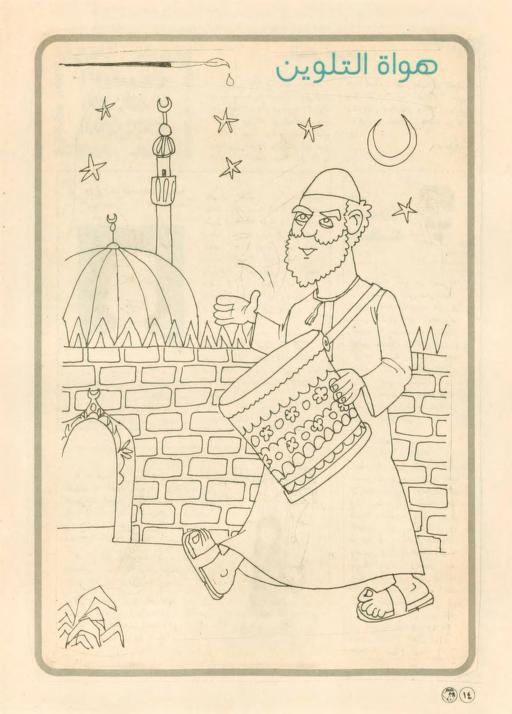
Celebrating Ramadan was also a notable theme. One specific Ramadan issue featured a blank illustration of a man holding a musaharati drum, ready to announce the pre-dawn meal, suhoor. Alongside this, another image depicted a boy and girl joyfully holding a fanous, the iconic Ramadan lantern. This exemplifies Eric Hobsbawm’s theory of the invention of tradition.9 While these practices have historical roots, their representation in the Magazine were a novel way for young readers to engage with and perpetuate these traditions, thus keeping them alive. The coloring activity also fostered a sense of shared experience across the Arab world as thousands of children engaged in it.
The commitment displayed by Majid Magazine to promoting Islamic values showcases an awareness of its role in shaping the spiritual and moral compass of its readership.
ENCOURAGING INTELLECTUAL CURIOSITY & LOVE FOR LEARNING
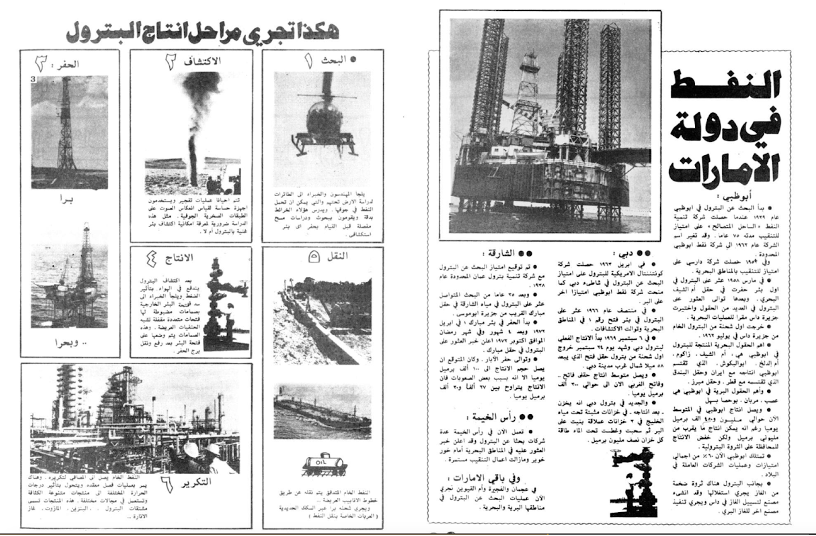
Another unique objective of Majid Magazine was its educational aim to foster intellectual curiosity amongst its readers. This included the creation of segments such as “The Garden of Knowledge”, which explained fun facts in an accessible way, and most notably, the introduction of the influential character Zakiya Al Thakiya. Through the Magazine, children were able to grasp complex topics and fuel their curiosity with information on a plethora of topics. For example, in one of its issues, Majid Magazine included a segment dedicated to oil extraction, the backbone of the economy at the time. This highlights how the Magazine strived to keep its readers informed on the country’s priorities and spark an early understanding of the nation’s economic foundation.
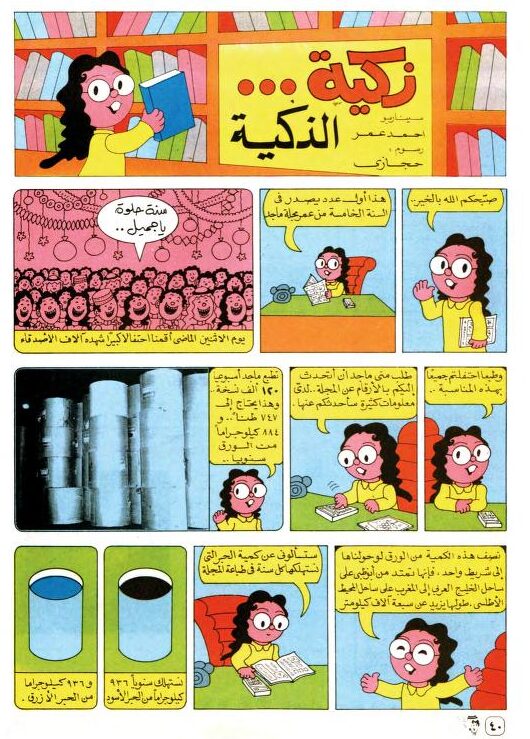
The introduction of the character Zakiya Al Thakiya was a notable decision by the Magazine. She was an embodiment of what a knowledgeable Arab child could look like and thus became a source of inspiration for many. Jehan Safar notes, “My favorite character was Zakiya Al Thakiya […] She was like an encyclopedia. Growing up, we obviously did not have access to information like we do today […] but reading Majid and learning from Zakiya was very rewarding. We were entertained and educated at the same time.”12
In celebration of Majid’s 5th year anniversary, Zakiya Al Thakiya explained to her readers the process of printing the Magazine. In the comic, she elaborated on the details of printing, such as the amount of paper and ink needed, and the time necessary to produce the full Magazine and release it every Wednesday across the Arab region. This allowed readers to understand the time and effort needed to create the issue in their hands.
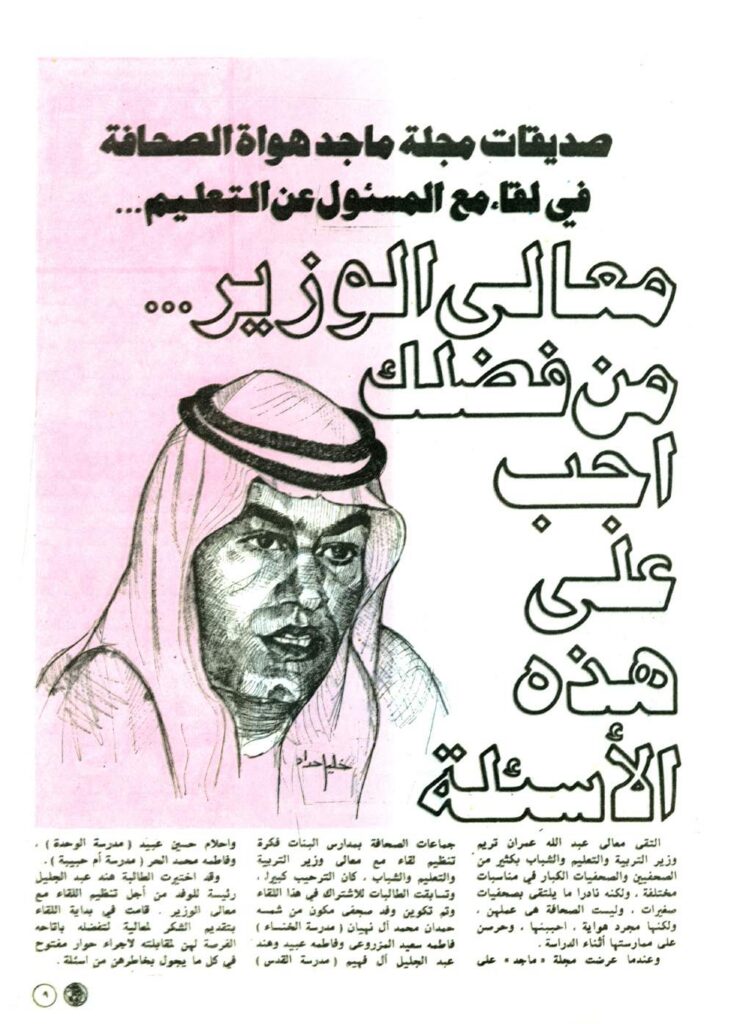
Amal Abdullah, another Emirati reader and educator interviewed for this Essay, highlighted how Majid inspired her to become a teacher.14 She noted that she and her fellow teachers also used the Magazine for their morning assembly, where they would have their students read a specific poem from the issue or re-enact a certain story that ends with a moral lesson. Abdullah also recalled a segment from the Magazine that included children sending their questions to the then Minister of Education, the late Abdulla Omran Taryam. This two-way communication ensured that educational policies and practices considered the needs and perspectives of the students they aimed to serve, while encouraging a more invested and engaged student body.
CHAMPIONING ARAB UNITY
In a region that is often marked by its divisions, Majid Magazine stood as a symbol of aspirational unity. Since its inception, it branded itself as a magazine for all Arab children, regardless of borders. In the interview conducted with Ahmad Omar, he stated that “the Magazine [was] directed to every child in the Arab world. It was the best ambassador for the UAE in every Arab village and city, read by all children every Wednesday morning.” The Magazine offered content that children across the Arab world could relate to, celebrating the rich diversity of Arab cultures and emphasizing their shared foundations. The Palestinian cause was one of the major issues that the Magazine highlighted in the 1980s and 1990s. A regular segment during this time extracted pieces of Israeli news and added a Palestinian perspective.16 This was a bold attempt at portraying political events to children, a rarity in Arab children’s media that usually steers away from delving into political issues. Majid Magazine also featured the late Paul Findley, then US Senator from Illinois, who declared his support for the Palestinian cause and criticized American foreign policy towards Israel.17 As Ahmad Omar recalls, “Senator Paul Findley published a book advocating for the Arabs and defending their cause. The Magazine wanted to announce its support for the Senator and so it published a summary of the book.”18 The Magazine went a step further by including a detachable letter pre-addressed to Senator Findley with space for a child’s name and address. On the other side, there was space to express support for Findley’s pro-Palestine views. According to Omar, hundreds of letters from Arab children reached Senator Findley which inspired him to take a trip to Abu Dhabi to meet the team behind the Magazine.19
In the same vein, a 1994 issue of the Magazine included a section titled “Gaza… Jericho…and the Rest will Come”, which reported on Israeli aggression towards Palestinian children, as well as mentions of historical anecdotes that highlighted the history of Palestine.20 Interestingly, an X user noted that Majid Magazine was the first medium through which she was introduced to the Palestinian issue.21 This highlights the long-lasting impact a magazine like Majid can have on a child’s perspective and political understanding.
CULTURAL DIPLOMACY IN ACTION
Beyond its vibrant illustrations and captivating narratives, Majid Magazine has emerged as a significant instrument of Arab cultural diplomacy. This was epitomized by the Magazine’s Pan-Arab team, featuring contributions from writers, artists, and creatives across the region. The integration of Majid into the fabric of the Arab cultural scene was marked by strategic distribution efforts. In Morocco, for instance, despite the dominance of established French publications, Majid carved a niche for itself by sending individual letters asking potential readers to engage with the Magazine, thus circumventing traditional distribution networks.22 In Sudan, according to Ahmed Omar, the Sudanese government offered to buy 100,000 copies every week and pay upfront after realizing that not enough copies were reaching Sudanese children because of logistical hurdles.23 While this deal did not ultimately go through, it demonstrates the appeal and reach Majid had across the Arab world.
Moreover, the Magazine’s distribution at regional gatherings underscored its diplomatic utility. As Jehan Safar explained about an initiative in 2000, “I was taking part in the annual Arab Child Conference in Amman, Jordan, and all the participants were asked to give something that represents their culture to the other participants. It was my idea to contact Al-Ittihad and ask them to provide 300 copies of Majid for us to take with us. They ended up giving us around 1,000 copies, and the feeling of pride that I felt that day did not leave me. Other kids were giving us perfume, food, and the likes to help us resonate with their culture. However, what came from the UAE was the gift of Majid, which is a symbol of culture, education, and entertainment. The astounded faces of the children when they received Majid was nothing like I have ever witnessed, they were all so happy to be getting copies.”24
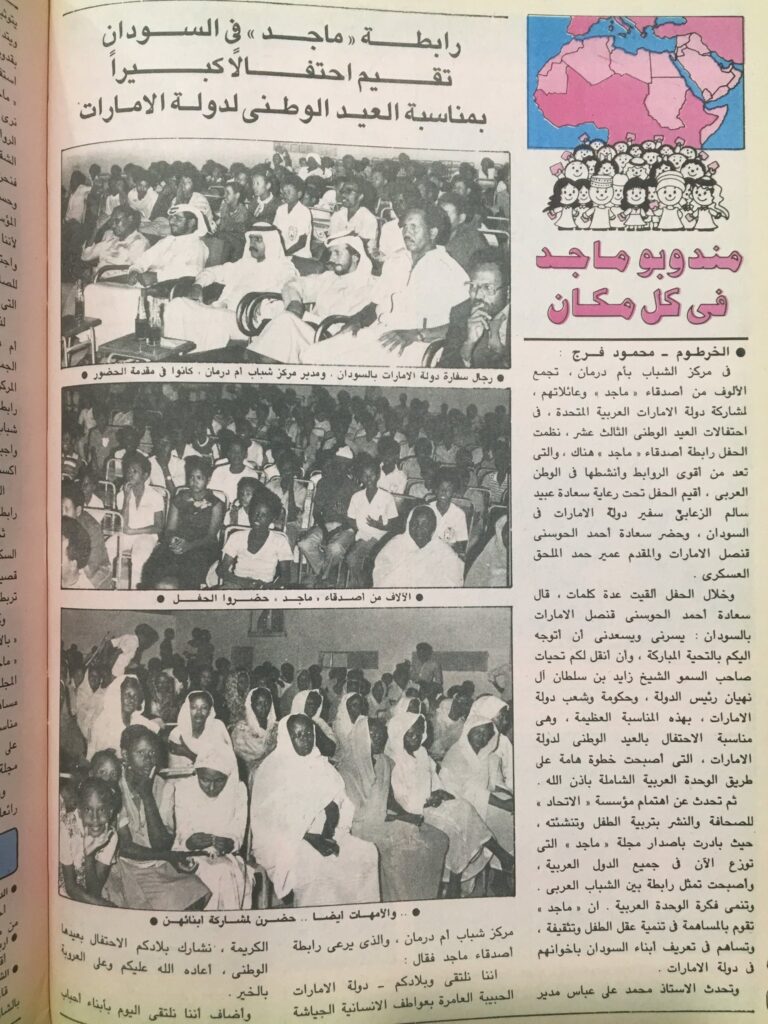
Majid Magazine also ran an Ambassadors program throughout its early decades which selected young writers who were interested in journalism and cultural exchange to provide them with a platform to publish. These Ambassadors, often chosen for their curiosity and engagement with their local communities, were tasked with reporting significant cultural, educational, and political events from their respective countries back to the Magazine for publication, creating a broader shared experience among Majid’s readership. One illustrative case involved a Sudanese Ambassador who covered the celebration of the UAE’s National Day in Sudan. Another noteworthy contribution was from a young Egyptian Ambassador who had the opportunity to sit down with a local politician to discuss the friendly ties between Egypt and the UAE. This interaction provided a platform for discussing the impact of diplomatic relations on youth initiatives and cultural exchange programs, further emphasizing the role of Majid Magazine as tool of regional soft power at the time. By incorporating reports from these young Ambassadors into its regular publications, the Magazine amplified the voices of the younger Arab generations, allowing them to contribute actively to the discourse on both cultural and political affairs.
PRESERVING THE ARABIC LANGUAGE
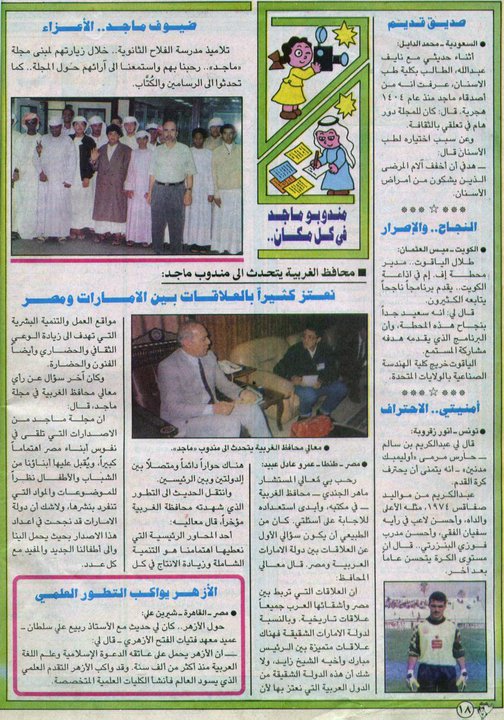
Majid Magazine’s strategic choice of disseminating its content in Arabic helped connect its readership to their cultural heritage and enhance their language proficiency. In her interview, Amal Abdullah stated that reading Majid every week is what enabled her to master the Arabic language, even more than her public schooling.27 The Magazine also encouraged young readers to write in Arabic, for example through its Ambassadors’ program, enabling children to express themselves in a way that was unprecedented for its time. It also encouraged young readers to engage with current events in Arabic, ensuring the language’s relevance in contemporary discourse and everyday communication.
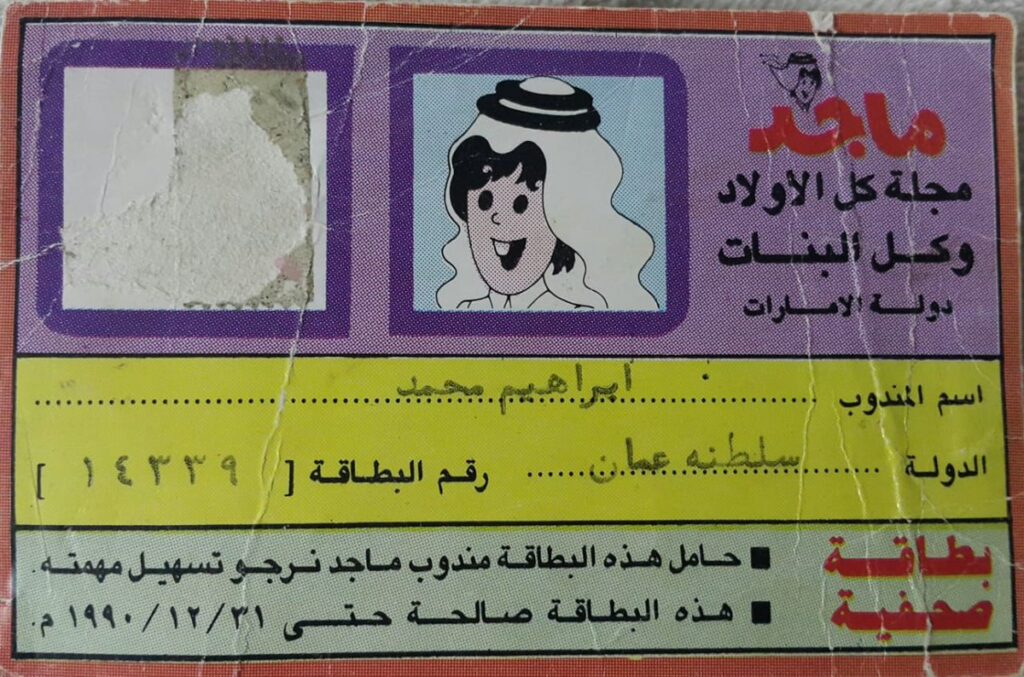
Majid Magazine created a bridge of continuity with the rich linguistic and cultural past of the Arab world. This came at a crucial point in the expansion of globalization, where the spread of English as a lingua franca risked diminishing native languages. Majid Magazine’s focus on Arabic not only educated its readers but also acted as a bulwark against the erosion of cultural identity, positioning the language as a vibrant and enduring element of Emirati heritage. Through these linguistic strategies, Majid Magazine not only contributed to the educational development of its readers but also played a significant role in the broader narrative of nation-building and cultural preservation within the country.
CONCLUSION: MAJID MAGAZINE’S LEGACY
The ever-evolving media landscape of the 2000s did not result in the end of Majid. The Magazine embraced new technologies by launching its own website in 2009 and creating a dedicated TV channel in 2015 with both old and new characters, including Majid. This allowed the Magazine to maintain its relevance with new generations through diverse digital forms of entertainment.
The Magazine’s mission still focuses on its core values that include enabling cultural exchange, promoting Arab unity, and enriching the feeling of national pride amongst its Emirati consumers. Majid Magazine’s legacy extends far beyond its physical pages. Through its commitment to national identity, education, unity, and linguistic preservation, Majid has played an instrumental role in shaping generations of Arab youth. The personal narratives shared by those who grew up with the Magazine testify to its enduring influence, highlighting its significance as a cultural institution that continues to inspire, educate, and unite. Majid Magazine is a rare case study that exemplifies how children’s print media can transcend their primary educational purpose to become a potent instrument of national identity formation and cultural diplomacy.
The statements made and views expressed are solely the responsibility of the author, and do not represent Fiker Institute. To access the endnotes, download the PDF.